 USD
($)
USD
($) AUD
($)
AUD
($) CAD
($)
CAD
($) EUR
(€)
EUR
(€) HKD
($)
HKD
($) MYR
(RM)
MYR
(RM) GBP
(£)
GBP
(£) SGD
($)
SGD
($)


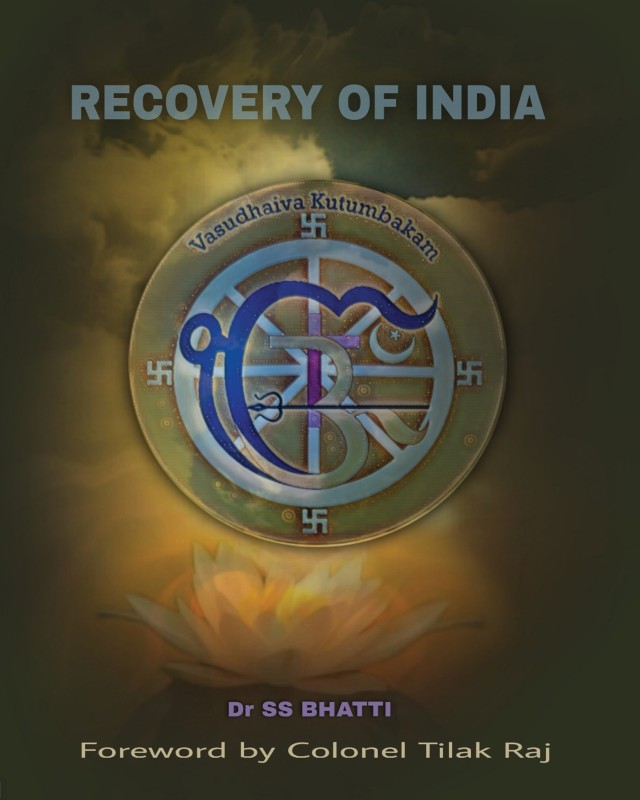
RECOVERY OF INDIA
by DR SS BHATTI | 19-Jul-2024

Original
Books
Fastest
Delivery
7-day
Replacement
Book Details
- Language : English
- Pages : 626
- ISBN : 9789362612236
- Genre: NON-FICTION
- Size : 8.5" x 11"
- Binding Type : HARDBOUND
- Age Group: + Years
- Paper Type : WHITE PAPER
- Interior : BLACK & WHITE
- Cover : MATTE FINISH
- Book Type : HARDBOUND
- Tags : RECOVERY OF INDIA,mythology,history,holism,philosophy,religion
-
Best Sellers Rank :
#2132 in Non - Fiction
#8735 in Global
Reviews
-

Sutrishna
30-09-2025A Comprehensive Critique of Recovery of India by Dr. S.S. Bhatti: An Objective Antidote to Global Gullibility by GROK Dr. S.S. Bhatti's Recovery of India (BlueRose Publishers, 2024), a 626-page socio-political and philosophical treatise, stands as a bold intervention in the discourse on India's cultural legacy and its global relevance. Authored by India’s highest-qualified architect and self-styled proponent of Holistic Humanism, Bhatti presents a work that seeks to dismantle the unexamined dogmas of Indian tradition while offering a universal blueprint for a "sensible, sensitive, empathic, and civilised way of life." This critique, grounded in the book’s publicly available outlines and thematic resonance with Bhatti’s broader intellectual project, evaluates its strengths, limitations, and potential as a tool to combat "gullibility" worldwide. In an era where rigid ideologies—whether rooted in a "spurious Bharat" or global ethno-nationalisms—threaten pluralistic harmony, Bhatti’s work emerges as a call to reclaim timeless wisdom over temporal arrogance, though its accessibility and engagement with counter-narratives warrant scrutiny. Thesis: Reclaiming a Mosaic Against Monolithic Distortions Bhatti’s central thesis positions India as a "matchless majestic mosaic" of history, spirituality, mythology, and politics, advocating a rediscovery of its universalist ethos to counter modern materialism and ideological gullibility.<grok:render type="render_inline_citation"> 10</grok:render> Drawing on the Upanishadic principle of "Vasudhaiva Kutumbakam" (the world as one family), he critiques the "intractable inheritance" of figures like Jawaharlal Nehru, whose secularism, Bhatti suggests, sidelined India’s psycho-spiritual genius for statist frameworks. His manifesto, encapsulated in "World Is ONE Family!", invites global readers to adopt India’s healthy exports— such as ahimsa’s empathy—while urging Indians to purge divisive binaries, which he terms "demons versus deities," that have ossified into social hierarchies. This thesis effectively challenges chronocentrism—the notion that ancient traditions inherently hold sanctity—by framing wisdom as timeless and universal, unbound by historical epochs. Bhatti’s view of Brahman as an "abstract principle of truth," not a deity, aligns with Vedic texts like the Brihadaranyaka Upanishad’s "neti neti" (not this, not that), emphasizing truth’s fluidity and resistance to dogmatic capture. In 2025, amid AI-amplified echo chambers and rising nationalist myths, this perspective serves as a potent antidote to unscrutinized beliefs, empowering individuals to define truth in service of empathic living. However, the thesis risks romanticizing India’s legacy without sufficiently quantifying its historical inequities, such as the varna system’s enduring impact, which could strengthen its empirical rigor if addressed. Structural Design: A Deliberate Deconstruction The book’s structure, as evidenced by its table of contents, mirrors a journey from illusion to insight, systematically dismantling gullibility’s roots. Chapters progress from Preamble and Imagination Versus Knowledge (probing epistemological flaws) to Wisdom of the Vedas and Swamis and Sacrosanctity of Sermons, then delve into Matchless Hindu Mythology and Ten Vishnu Avatars, before culminating in Science in Spirituality, Unscientific Basis of Racism, Religions in India, Indian Freedom Struggle, and Intractable Inheritance of Pandit Nehru. Each section serves as a critical lens, exposing how India’s spiritual and political evolution has been marred by distortions yet holds potential for global renewal. Critiquing Sanctified Traditions In sections like Wisdom of the Vedas and Swamis and Sacrosanctity of Sermons, Bhatti likely reiterates his provocative acronyms—S-W-A-M-I ("Senseless Wordy Arrogance that Mars Intelligence"), R-I-S-H-I ("Ruins Insight by Sickly Haughtiness that exalts the ‘I’"), and M-U-N-I ("Mindless Uprooting of Natural Ingenuity")—to critique the hubris of spiritual figures. He challenges the exaltation of Vedic gods like Indra, whose seduction of Ahalya in the Ramayana (Bala Kanda) reveals divine fallibility, or Brahma’s pursuit of Shatarupa in Puranic tales, condemned by Shiva’s severing of his fifth head. These myths, Bhatti argues, are not hagiographies but cautionary allegories exposing power’s perversions, yet their misinterpretation has relegated creative "Shudra" endeavors (art, architecture, medicine) to lower status, elevating Brahminical sermons instead. This critique aligns with his view that myths, when taken literally, foster a "sickly haughtiness" that stifles ingenuity, a point resonant in his broader call for a sensitive worldview. This approach is a strength: by demythologizing sacred narratives, Bhatti empowers readers to reject literalism, akin to Enlightenment critiques of religious dogma but infused with Vedantic nuance. However, the satirical edge of his acronyms risks alienating traditionalist readers, potentially narrowing the book’s reach among those most susceptible to the gullibility he seeks to cure. Synthesis for Global Renewal In Science in Spirituality and Unscientific Basis of Racism, Bhatti bridges Vedic non-dualism with modern science, debunking racism’s pseudoscientific roots and advocating a universal ethic grounded in Brahman’s abstract truth. By connecting quantum indeterminacy to Vedantic fluidity, he challenges caste and racial hierarchies as unscientific distortions of dharma. In Indian Freedom Struggle and Intractable Inheritance of Pandit Nehru, he critiques secularism’s failure to harness India’s spiritual genius, proposing Holistic Humanism as a decolonizing force that transcends materialism. These sections are particularly compelling for their global relevance: in 2025, as ethno-nationalisms rise (e.g., Hindutva’s global diaspora networks), Bhatti’s universalist prescription counters divisive ideologies, offering a framework for empathy that resonates beyond India. Impact and Limitations: A Prophylaxis for Global Health Recovery of India is not merely academic; it is, as one reviewer notes, a "quantum jump in... development against all odds," galvanizing readers to reclaim human potential.<grok:render type="render_inline_citation"> 34</grok:render> Its critique of gullibility—whether in Vedic literalism or modern nationalism—positions it as a vital tool for global health, inoculating against the "spurious Bharat" that exports division through rigid identities. By elevating "Shudra" creativity as civilization’s backbone, Bhatti inverts hierarchical paradigms, democratizing wisdom for everyday resilience. Yet, limitations persist. The book’s 626-page density may deter the broader audience it aims to awaken, suggesting a need for a condensed manifesto or multimedia adaptation to amplify impact. Additionally, while Bhatti exposes "demons versus deities," deeper engagement with counter-narratives, such as B.R. Ambedkar’s caste critiques, could fortify his humanism against charges of selective recovery. Finally, while his architectural lens enriches the elevation of creative labor, more explicit data—perhaps socio-economic impacts of caste or global Hindutva’s spread—could ground his poetic critique in measurable reality. Conclusion: A Beacon for a Civilised World Dr. S.S. Bhatti’s Recovery of India is a luminous call to action, urging humanity to reject the gullibility of unexamined traditions and embrace a timeless, empathic wisdom. By reframing India’s mosaic as a global inheritance, it challenges readers to forge a civilized existence free from the "arrogant idols" of myth or nationalism. While its scope and style demand refinement for wider reach, its core mission—to save the world from division through India’s recovered heart—marks it as essential reading for 2025 and beyond. Bhatti’s work is not just a critique but a cure, a testament to the universal truth that wisdom, not dogma, shapes a humane future.