
Adverbial Phrases: Learn Usage With Clear Examples

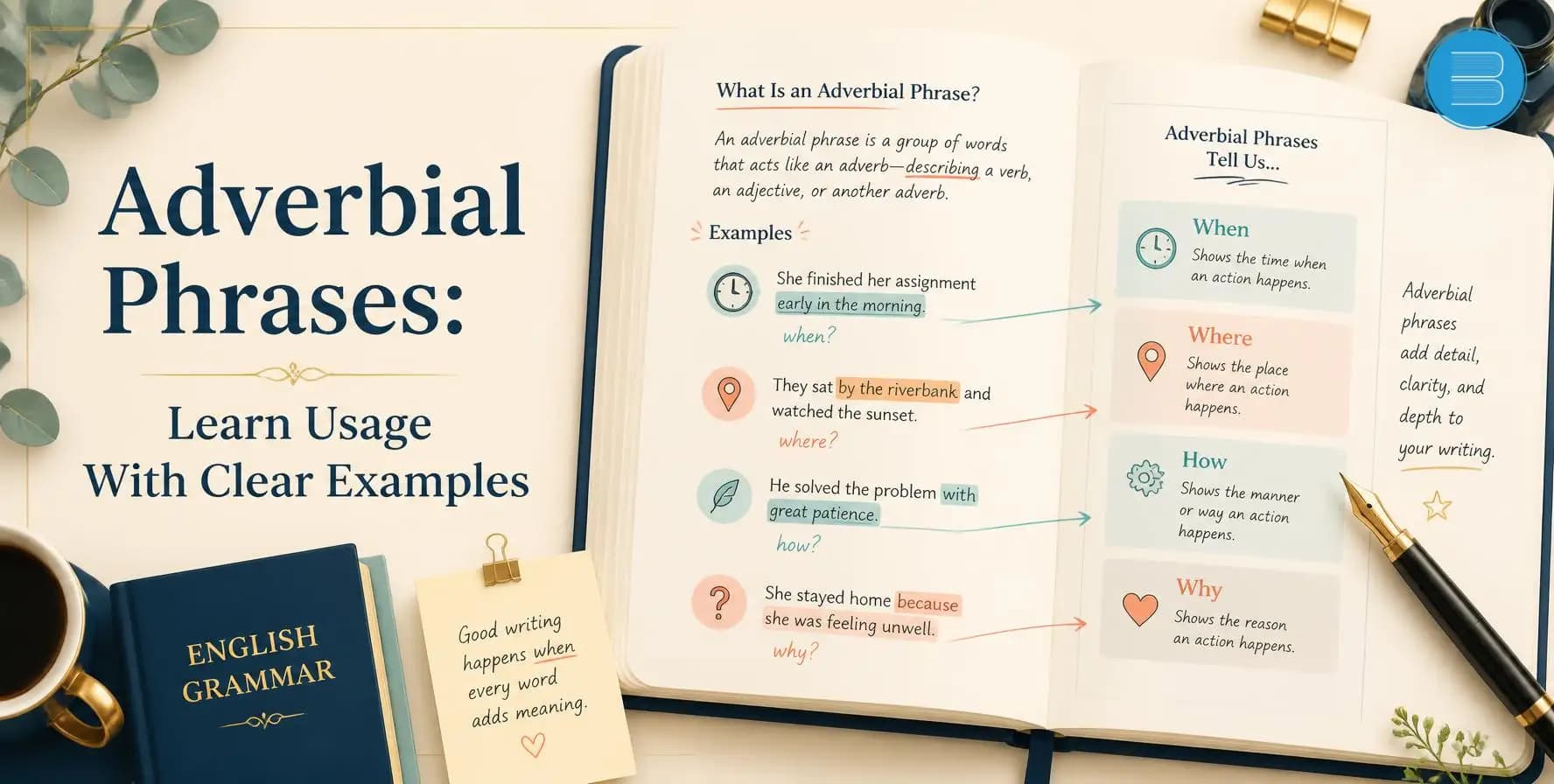
Good writing not only lets the readers know what happens but also enables them to know when, where, why, how, and under what conditions something has happened. This is where adverbial phrases come into play.
Compare these two sentences:
- The poet wrote.
- The poet wrote late into the night.
The second sentence provides a clearer understanding. The expression late into the night tells us about the timing of the event, hence its role as an adverbial.
This article is sure to demystify for you what an adverbial is all about, how an adverbial phrase differs from an adverbial clause, and how to understand the meaning of adverbials within a sentence.
An adverbial can be a word, phrase or a clause that serves an adverbial purpose. Cambridge Dictionary defines an adverbial as a word or phrase which acts as an adverb.
Adverbials are not only important in the study of grammar but also useful for writers, poets, students, and even general readers.
Table of Content
What Are Adverbial Phrases?
An adverbial phrase is a group of words that functions like an adverb. It gives additional information about an action, description, or sometimes an entire sentence.
An easy way to identify one is to ask questions such as:
- When?
- Where?
- How?
- Why?
- How often?
- To what degree?
- Under what circumstances?
For example:
The children played in the garden.
The phrase in the garden tells us where the children played. Therefore, it functions as an adverbial phrase.
Another example:
She answered the question with great confidence.
The phrase with great confidence explains how she answered.
Adverbial Meaning in Simple Terms
The simplest adverbial meaning is:
An adverbial is a word or group of words that adds information about an action, description, or sentence.
Notice that an adverbial does not have to be a traditional adverb ending in -ly.
Consider:
He ran quickly.
Here, quickly is an adverb.
But:
He ran at remarkable speed.
Here, at remarkable speed is a phrase functioning adverbially.
This distinction is important because function matters more than form.
You may also like: Motivational Books for Men to Build a Stronger Mindset
You may also read: 10 Best Audiobook Apps to Find Books Worth Listening To
Adverbial Definition and Examples
An adverbial can be defined in practice as an element of a sentence that contributes to the circumstances of an action or a claim.
Here are some straightforward examples:
| Sentence | Adverbial | Question answered |
| She arrived after sunset. | after sunset | When? |
| He waited outside the library. | outside the library | Where? |
| They spoke with great enthusiasm. | with great enthusiasm | How? |
| We stayed home because of the storm. | because of the storm | Why? |
| She visits us once a month. | once a month | How often? |
| He was extremely nervous. | extremely | To what degree? |
The most important thing to remember here is that these expressions have an adverbial function.
According to Cambridge, adverbials may comprise time expressions, for example, yesterday, always, and in the meantime, whereas a noun phrase may be adverbial depending on how it is used in the sentence.
Types of Adverbial Phrases
Adverbial phrases can communicate different kinds of information. Learning these categories makes them much easier to recognize.
1. Adverbial Phrases of Time
These tell readers when an action happens.
Examples:
- in the morning
- after dinner
- before sunrise
- during the summer
- late at night
- every Saturday
Examples in sentences:
She writes early in the morning.
We finished the manuscript before midnight.
The library closes after sunset.
For writers, time adverbials are especially useful when moving between scenes.
Instead of:
He entered the room. He had been there before.
You could write:
Years earlier, he had entered the same room.
The adverbial immediately establishes temporal context.
You may also read: Christmas Books to Read This Holiday Season – Explore
2. Adverbial Phrases of Place
These tell readers where something happens.
Examples include:
- under the bridge
- near the river
- inside the house
- behind the curtain
- across the street
- at the end of the road
For example:
The children were playing behind the old house.
She discovered the letter under the wooden table.
Place adverbials can be particularly effective in fiction because they help readers visualize a scene.
3. Adverbial Phrases of Manner
These explain how something happens.
Examples:
- with confidence
- in complete silence
- with great care
- without hesitation
- in a friendly manner
Examples:
She opened the envelope with trembling hands.
The actor walked onto the stage with complete confidence.
He answered the question without hesitation.
Manner adverbials are valuable for authors because they can reveal character without directly explaining personality.
Compare:
Maya was nervous.
with:
Maya entered the room with shaking hands.
The second sentence allows the reader to infer her emotional state.
4. Adverbial Phrases of Frequency
These tell us how often something happens.
Examples:
- once a week
- every morning
- from time to time
- twice a year
- on most occasions
Examples:
She visits the bookstore once a week.
He reads poetry from time to time.
We meet every Friday evening.
Frequency adverbials are useful when establishing habits, routines, or repeated events.
5. Adverbial Phrases of Reason or Cause
These explain why something happens.
Examples:
- because of the rain
- due to the delay
- as a result of the accident
- because of his illness
- for this reason
Examples:
The match was canceled because of the rain.
She missed the train because of the traffic.
Be careful not to confuse every phrase beginning with because of with an adverbial clause. Because of the rain is a phrase, while because it was raining contains a subject and verb and forms a clause.
You may also like: Top 5 Reading Before Bed: Build a Calmer Nighttime Routine
You may also read: Books for Stress Relief: Read Your Way to a Calmer Mind
6. Adverbial Phrases of Degree
These express how much or to what extent.
Examples:
- to a great extent
- by far
- quite significantly
- to some degree
- a little
Examples:
The ending was surprisingly emotional.
The new approach improved the results to a great extent.
Degree expressions can modify adjectives, adverbs, verbs, or larger structures depending on their construction.
Adverbial Phrases vs Adverbial Clauses
Adverbial Phrase
An adverbial phrase is a group of words that functions like an adverb by modifying a verb, adjective, or another adverb. Unlike an adverbial clause, it does not contain a subject and a finite verb. For example, in “She arrived after the meeting,” the phrase explains when she arrived.
She left after dinner.
After dinner is an adverbial phrase.
Adverbial Clause
An adverbial clause is a group of words containing a subject and a verb that functions like an adverb. It modifies a verb, adjective, or another adverb by showing time, reason, condition, place, or manner. It usually begins with subordinating conjunctions such as because, although, when, if, or while.
She left after she finished dinner.
After she finished dinner is an adverbial clause.
Compare them:
| Adverbial phrase | Adverbial clause |
| after dinner | after she finished dinner |
| because of the rain | because it was raining |
| before sunrise | before the sun rose |
| despite the difficulty | although the task was difficult |
| during the meeting | while the meeting was happening |
This distinction becomes particularly useful when editing longer sentences.
You may also like: Mark Minervini Books: Learn His Trading Strategies & Ideas
You may also read: Inspirational Writing Quotes to Spark Your Creativity
How to Identify Adverbial Phrases
Finding an adverbial phrase becomes easier when you use a simple process.
Step 1: Find the Main Action
Locate the main verb.
The novelist worked in the library.
The main action is worked.
Step 2: Ask a Question
Ask:
- When?
- Where?
- How?
- Why?
- How often?
Here:
Where did the novelist work?
Answer:
in the library
Therefore, in the library is functioning as an adverbial.
Step 3: Check What the Phrase Modifies
Determine what information the phrase adds.
The novelist worked quietly in the library.
Here:
- quietly → manner
- in the library → place
Both provide additional information about the action worked.
Step 4: Remove It Temporarily
Try removing the phrase.
The novelist worked.
The sentence remains grammatically complete, although less informative.
This is a useful practical test, but remember: not every removable phrase is automatically an adverbial. You should still consider its function in the sentence.
Position can change emphasis and sometimes clarity.
Adverbs and adverb phrases can occur at the beginning, middle, or end of a clause.
Adverbial Phrase Position within a Sentence
Beginning Position
After midnight, the poet finally finished the draft.
Starting with an adverbial can establish context before the main action.
This is particularly useful in storytelling.
Middle Position
The poet carefully revised the final stanza.
Some adverbials naturally occur in the middle, especially shorter adverbs and expressions of frequency.
She usually reads before bed.
End Position
The poet finished the draft after midnight.
This is often the most natural position for adverbials of manner, place, and time.
Cambridge’s grammar guidance notes that manner, place, and time expressions commonly occur toward the end of a clause, with their preferred order often depending on the combination being used.
Adverbial Phrases in Creative Writing
For poets and authors, grammar becomes a creative tool.
Adverbial phrases can help you control pace, atmosphere, movement, setting, and emphasis.
Consider:
The woman walked.
It communicates an action, but little else.
Now compare:
The woman walked slowly through the abandoned station.
The adverbial information gives the reader a stronger sense of movement and setting.
You can take it further:
Through the abandoned station, the woman walked slowly, listening for footsteps.
The placement changes the rhythm and draws attention to the setting.
Use Adverbials to Build Atmosphere
The moon appeared above the silent rooftops.
He waited beneath the flickering streetlight.
She whispered in the darkness.
These phrases do more than answer grammar questions. They contribute to the emotional experience of the scene.
Use Them to Control Pacing
Compare:
He opened the letter.
with:
He opened the letter after several long minutes.
The second sentence slows the moment down.
This is an important lesson for fiction writers: an adverbial can influence not only meaning but also narrative pace.
A Simple Formula for Better Adverbial Usage
When writing or editing, use this three-part approach:
Action + useful circumstance + clear placement
For example:
She whispered in the darkness.
Action = whispered
Circumstance = in the darkness
Placement = clear and natural
Or:
After midnight, he finally completed the poem.
Action = completed
Circumstance = after midnight
Placement = intentionally fronted for emphasis
Prior to the insertion of an adverbial, one might consider the following questions:
- Is this piece of information necessary for the reader?
- Will this make the action clearer?
- Is this adverbial close enough to its referent?
- Does this enhance the flow of language?
- Would a more powerful verb achieve the same goal?
Final Thoughts
Understanding the concept of an adverbial phrase gets considerably simpler once the notion of a difficult grammar term is replaced by the practical role of an adverbial.
Adverbials provide the readers with information related to time, place, manner, frequency, cause, degree, and condition. They are capable of making common sentences more detailed, assisting writers in building up the setting of a scene, and giving poets control over the rhythm and imagery of the verses.
There is one main thing that needs to be understood:
An adverbial is determined not only by its grammatical form but by its function in the sentence.
Therefore, while editing your next story, poem, article, or even the whole manuscript, think about the adverbial phrases you have included in the text, and not just about the particular adverbs themselves.



0 Comments