
Freytag Pyramid: Definition, Structure and Examples

Every great story has a framework, regardless of whether the writer intentionally adheres to it. For millennia, storytellers have used frameworks to create engaging narratives. One of the most ageless and powerful forms is Freytag’s Pyramid, a storytelling framework that divides a story into different sections. But why should you, as a writer, devote the time to learning it? This article delves into the details of Freytag’s Pyramid and shows how learning it can help you improve your writing.
Origins of Freytag’s Pyramid
Gustav Freytag and His Contributions
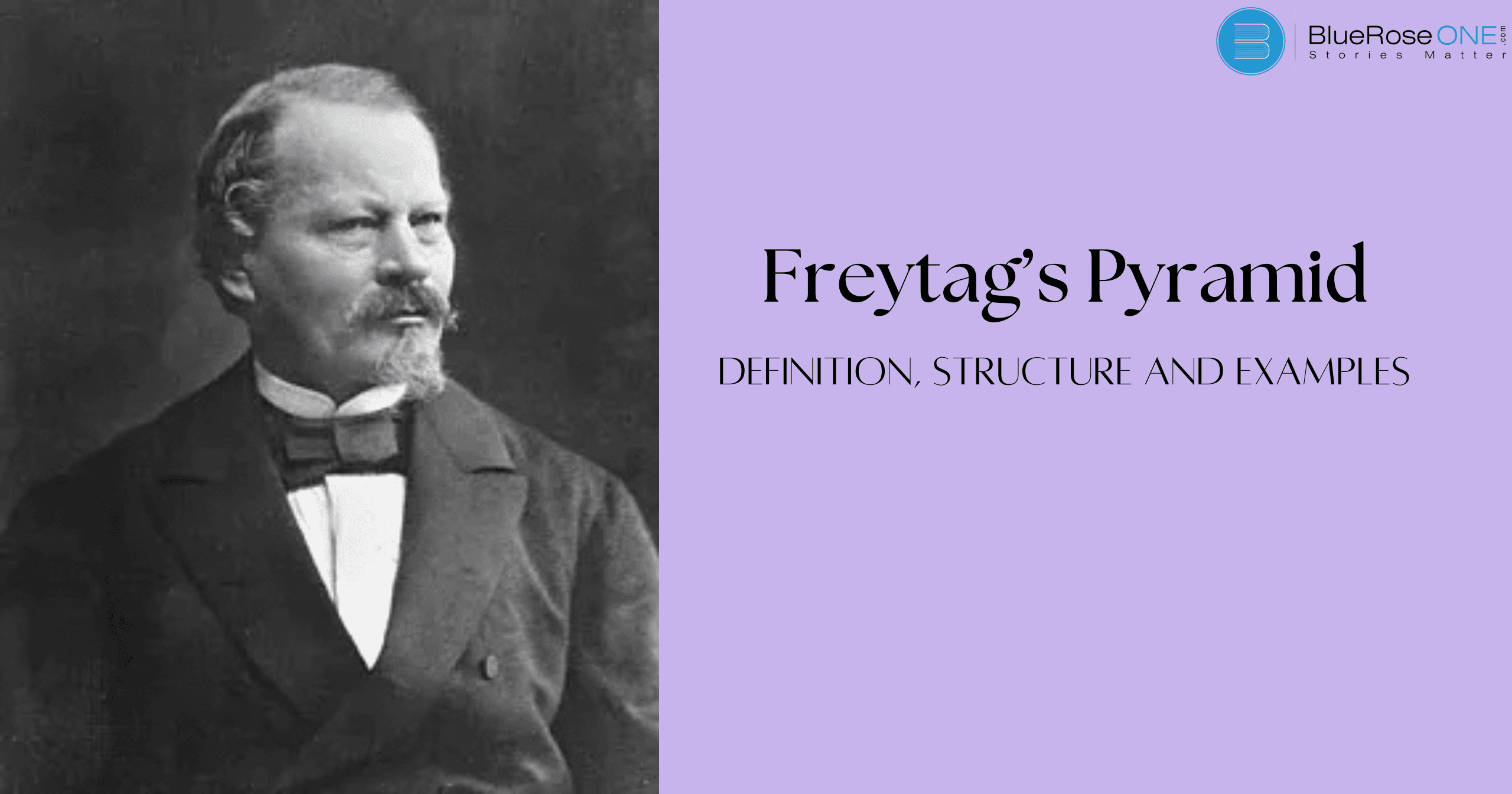
In his work Die Technik des Dramas (The Technique of Drama), German novelist and dramatist Gustav Freytag proposed a theory for analyzing dramatic structures in the mid-nineteenth century. His pyramid-shaped paradigm established the foundation of literary analysis and is still extensively employed today.
How the Pyramid Shaped Literary Theory
Freytag’s Pyramid formalized how writers and scholars perceive narrative arcs, bridging the gap between old storytelling practices and modern literature.
You may also read: How to Publish a Book? | Publish Your Book | BlueRoseOne
You may also like: 100+ Mood Words List to Describe Moods
The Structure of Freytag’s Pyramid
Exposition
The exposition is the basis of Freytag’s Pyramid, from which the story begins. It introduces the primary characters, environment, and necessary background information to help readers grasp the story’s world.
This stage establishes the tone and context, laying the framework for conflict to occur. A well-crafted exposition piques the audience’s attention without overwhelming them with details, keeping them engaged and ready to follow the story’s advancement.
It holds everything else together For example, in Pride and Prejudice, Jane Austen introduces the Bennet family and their societal challenges in the exposition.
Rising Action
Rising action marks the point in Freytag’s Pyramid that the plot begins to create suspense and excitement. It begins after the introduction and builds to the conclusion.
During this stage, characters endure challenges, tensions deepen, and the stakes rise. The growing action keeps readers interested by building suspense and emotional attachment to the plot.
This section is critical for establishing the storyline and ensuring that the climax has maximum impact, making it an essential component of engaging storytelling.
Climax
In Freytag’s Pyramid, the climax is the point at which a story’s suspense peaks. It is the point at which the protagonist encounters their most difficult task or makes a vital decision that impacts the plot’s outcome.
The climax, located at the summit of the pyramid, drives the story’s resolve by shifting from rising to falling action. Mastering this section enables writers to keep readers engaged and generate impactful stories.
Falling Action
The falling action stage in Freytag’s Pyramid occurs after the climax and begins to resolve the story’s tension. It depicts the aftermath of the climax as events begin to calm and lead to the resolution.
This phase frequently resolves loose ends and addresses questions addressed earlier in the story. For writers, creating a compelling falling action ensures that the story flows seamlessly to its end, keeping readers interested while also offering closure.
You may also like: What is Plot Structure? Definition with Examples
Benefits of Using Freytag’s Pyramid
Clarity in Storytelling
Freytag’s Pyramid assists writers in achieving clarity in storytelling by dividing the tale into five separate stages: exposition, rising action, climax, falling action, and resolution.
This framework guarantees that the plot flows logically, making it easier for readers to understand and participate with the story. By dividing the story into distinct sections, writers may highlight significant points, eliminate confusion, and keep a consistent pace.
Ultimately, this clarity improves the reader’s experience and keeps them engaged in the story.
Enhancing Reader Engagement
Freytag’s Pyramid contributes to the development of a structured narrative that keeps readers engaged from beginning to end.
Writers can create tension and emotional depth by following the five steps of the pyramid: exposition, rising action, climax, falling action, and resolution.
This format takes readers on a captivating journey, with each stage increasing suspense and leaving them hungry to find out what occurs next. A well-paced novel that employs Freytag’s Pyramid can capture the reader’s attention and keep them engrossed in the plot.
Universality of the Structure
One of the primary advantages of employing Freytag’s Pyramid is its universality of structure. This strategy works effectively in a variety of genres and storytelling mediums, including novels and films.
The pyramid’s clear, structured outline which includes exposition, rising action, climax, falling action, and resolution allows writers to produce a balanced and interesting narrative.
By adopting this paradigm, writers may ensure that their stories flow naturally, allowing readers to connect with the plot regardless of medium or style.
You may also like: What is an Epigraph in Literature? Definition and Examples
Applying Freytag’s Pyramid to Modern Writing
Adapting to Nonlinear Narratives
Adapting Freytag’s Pyramid for nonlinear storylines can be tough yet rewarding. While Freytag’s Pyramid follows a specific order of events (exposition, rising action, climax, declining action, and resolution), nonlinear stories hop around in time.
To use this structure, writers should concentrate on sustaining emotional highs and lows, even if the timeline is not linear. Writers can create suspense and deeper connections by strategically arranging major plot events, such as the climax, throughout the novel. This ensures that the narrative continues to build successfully.
Practical Tips for Writers
- Start by outlining your story according to the pyramid’s five stages.
- Focus on creating a compelling climax.
- Review and revise to ensure smooth transitions between sections.
Examples of Freytag’s Pyramid in Action
Classic Literature Examples
Shakespeare’s Hamlet is a textbook example of Freytag’s Pyramid, with its clear exposition, rising action, and tragic denouement.
Modern Example
Shakespeare’s Hamlet is a textbook example of Freytag’s Pyramid, with its clear exposition, rising action, and tragic denouement.
You may also like: What is a Character Arc? 3 Types with Examples from Fiction
Common Misconceptions About Freytag’s Pyramid
Myth: It Only Works for Linear Stories
One prevalent misperception regarding Freytag’s Pyramid is that it is only applicable to linear narrative. In truth, Freytag’s Pyramid is a versatile tool that may be used for any style of narrative, including non-linear and experimental ones.
Whether the story unfolds in a linear order or leaps across timeframes, the pyramid can help structure important parts such as exposition, rising action, climax, and conclusion, making it applicable to any plot structure. It is important to learn how to properly balance tension, conflict, and resolution.
Myth: It Limits Creativity
A prevalent misperception about Freytag’s Pyramid is that it restricts originality by forcing writers to follow a fixed format. In actuality, it functions as a guide rather than a rulebook.
The pyramid provides a clear framework for tale progression, but it does not limit how a writer approaches the narrative. Writers can experiment with tempo, character arcs, and twists. Freytag’s Pyramid simply helps ensure that the story remains engaging and well-paced from start to finish.
Tools and Resources to Master Freytag’s Pyramid
- Books: The Anatomy of Story by John Truby
- Online Courses: MasterClass on storytelling
- Software: Tools like Scrivener and Plottr
Why Every Writer Should Learn Freytag’s Pyramid
Freytag’s Pyramid is a storytelling framework that aids writers in developing well-structured and compelling stories. Gustav Freytag created it to explain the five major components of a story: exposition, rising action, climax, falling action, and resolution. Learning this pyramid is useful because it helps writers build tension and keep readers intrigued from beginning to end.
By understanding how each element links, authors can avoid classic problems like slow beginnings or hasty conclusions. Whether you’re writing a novel, movie, or short story, Freytag’s Pyramid offers a straightforward framework for organizing ideas and creating a fulfilling narrative experience.
Conclusion
Freytag’s Pyramid is more than simply a relic of literary theory; it’s a useful tool for contemporary writers. Mastering its structure allows you to ensure that your stories, regardless of genre, engage with people. So why not try it? Your next great story could be just one pyramid away.
Frequently Asked Questions
What is the primary purpose of Freytag’s Pyramid?
It provides a structured approach to crafting narratives.
Can Freytag’s Pyramid be used for short stories?
Absolutely! The pyramid is adaptable to any narrative length.
How does Freytag’s Pyramid apply to modern screenwriting?
Screenwriters use it to outline key moments, ensuring a gripping narrative arc.
What is the difference between Freytag’s Pyramid and the Three-Act Structure?
The pyramid breaks the story into five parts, while the Three-Act Structure focuses on three broader sections.
Are there tools to help writers implement Freytag’s Pyramid?
Yes, tools like Plottr and Scrivener are excellent for outlining narratives based on this structure.



0 Comments