
Furthermore Synonyms and Antonyms for Authors: Write Clearly

“Furthermore” is often a writer’s choice for adding another point in support of the previous one or making a smooth transition between two ideas. However, the use of the same transition time after time makes even meaningful texts boring.
Furthermore Synonyms and Antonyms will give writers opportunities to manage the tone, the pace, and the emphasis of their writing better.
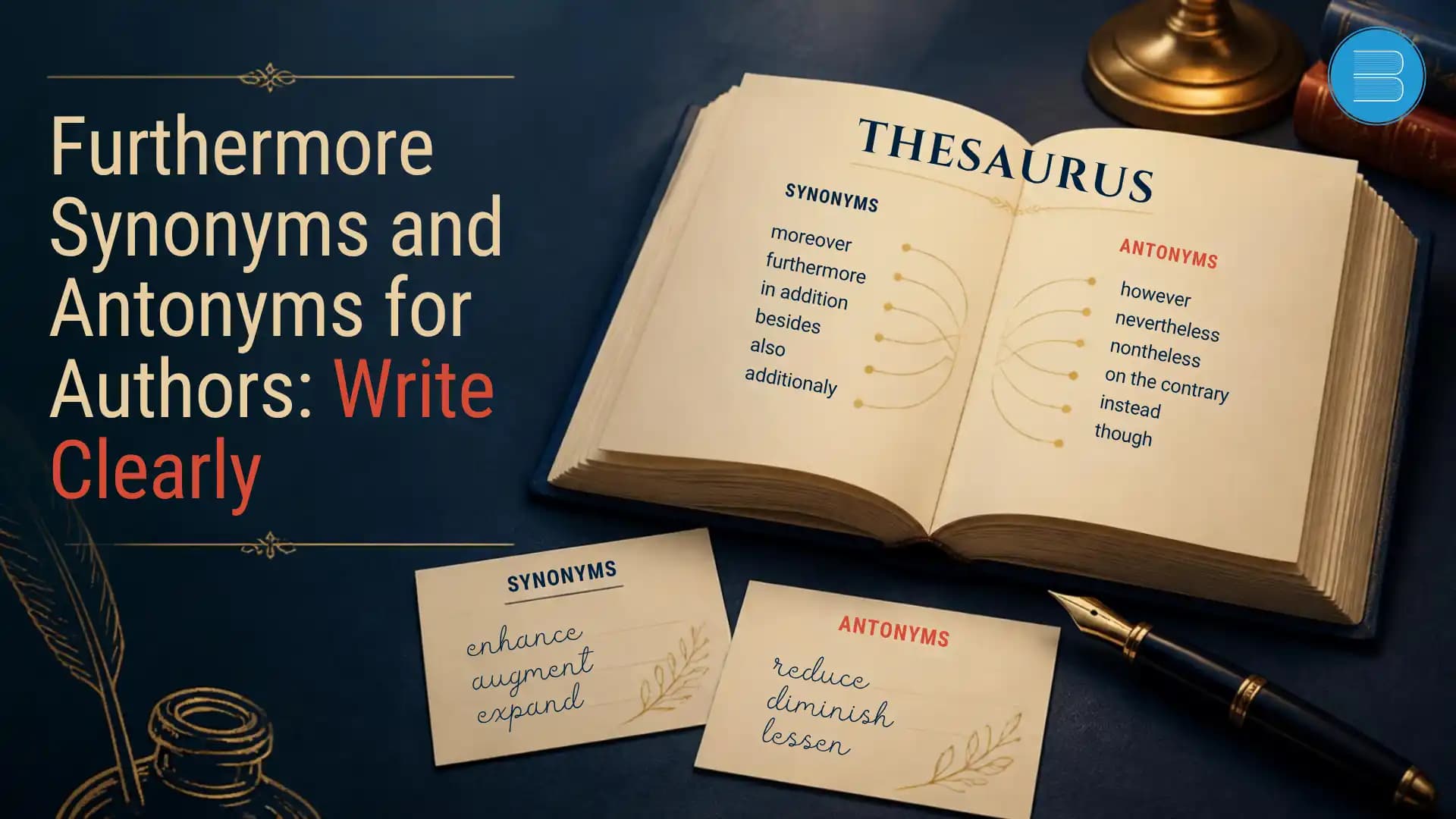
What is a synonym for furthermore? It depends on the context of your sentence: you may decide to use such words as “moreover,” “additionally,” “in addition,” “also,” “besides,” “what’s more,” “as well,” or “on top of that.”
Nevertheless, sometimes these synonyms are not interchangeable – depending on the purpose of your writing, they may be academic or informal and may be used to start the presentation of contrasting ideas rather than just supportive ones.
This article explains the meaning of “furthermore,” its synonyms and alternative phrases for certain contexts, antonym-like expressions, and provides examples of each of them in fiction, essays, blog posts, poems, academic writing, and other types of texts.
What Does “Furthermore” Mean?
Furthermore is an adverb used to introduce additional information. It generally means “in addition” or “more importantly.” Cambridge Dictionary classifies it as a formal word and identifies “moreover” as a synonym.
For example:
The novel has a compelling plot. Furthermore, its characters feel remarkably realistic.
The first sentence presents one positive quality. The second adds another related point.
“Furthermore” is especially useful when the additional information supports or strengthens what came before.
Simple Meaning of Furthermore
In simple terms:
Furthermore = in addition + another supporting point
For example:
- The book is beautifully written. Furthermore, it is easy to understand.
- The character is intelligent. Furthermore, she is highly resourceful.
- The research is detailed. Furthermore, it offers practical recommendations.
The word usually connects ideas rather than replacing a noun, verb, or adjective.
Furthermore Synonyms and Antonyms: Quick Reference
Before exploring individual words, here is a practical comparison.
| Alternative | Meaning/Function | Tone | Example |
| Moreover | Adds an important supporting point | Formal | Moreover, the evidence is convincing. |
| Additionally | Adds another piece of information | Formal/neutral | Additionally, the author includes examples. |
| In addition | Adds information | Neutral/formal | In addition, readers receive useful notes. |
| Also | Adds information | Neutral | The story is also emotionally powerful. |
| Besides | Adds another reason or point | Conversational | Besides, the ending is unforgettable. |
| What’s more | Adds an appealing or important point | Conversational | What’s more, the book is affordable. |
| As well | Adds information | Neutral | The guide explains grammar as well. |
| On top of that | Adds another point, often emphatically | Informal | On top of that, the illustrations are beautiful. |
| However | Introduces contrast | Neutral/formal | However, the ending divides readers. |
| In contrast | Shows difference | Formal | In contrast, the sequel is much darker. |
| Conversely | Presents an opposite situation | Formal | Conversely, some readers prefer the original. |
This last category should not be considered as true dictionary opposites. Instead, they serve the opposite purpose of discourse: while the former add another point to support their argument, the latter bring about an opposite purpose to the discourse.
20+ Furthermore Synonyms for Writers
There is no single replacement for “furthermore” that works in every sentence. The best choice depends on your audience, genre, and intended emphasis.
1. Moreover
Moreover is probably the closest formal alternative to “furthermore.” Cambridge Dictionary describes it as a word used to add information, particularly information that is also important.
Example:
The protagonist is courageous. Moreover, she refuses to abandon her friends.
Best for: academic writing, essays, professional writing, literary criticism, and formal articles.
2. Additionally
Additionally means “also” or “in addition.” It is useful when you want to introduce another factual point without giving the word excessive emotional weight.
Example:
The course teaches storytelling. Additionally, it covers character development.
Best for: reports, guides, articles, business writing, and academic content.
3. In Addition
In addition is a clear and versatile alternative.
Example:
The publisher provides editing support. In addition, authors receive formatting assistance.
It works particularly well when clarity matters more than stylistic sophistication.
Best for: explanatory writing, essays, reports, blogs, and instructional content.
4. Also
Sometimes the strongest alternative is the simplest one.
Example:
The poem is emotional. It is also beautifully structured.
“Also” is less formal than “furthermore,” but that can be an advantage. It sounds natural and rarely distracts the reader.
Best for: general writing, blogs, fiction, personal essays, and conversational content.
5. Besides
“Besides” can add another fact or, especially in conversational writing, introduce an additional reason.
Example:
I recommend this novel. Besides, it is an excellent introduction to the genre.
Cambridge Grammar notes that “besides” can be used at the beginning of a clause to add a fact or reason that is stronger than the previous point.
Best for: dialogue, informal essays, opinion writing, and conversational content.
6. What’s More
“What’s more” adds information with a little more energy.
Example:
The book is beautifully illustrated. What’s more, the story is suitable for young readers.
It feels warmer and more conversational than “furthermore.”
Best for: blogs, reviews, marketing copy, lifestyle writing, and friendly articles.
7. As Well
“As well” is a natural way to add information, especially when placed at the end of a sentence.
Example:
The novel explores grief and family relationships as well.
It does not always function as a direct sentence-opening replacement for “furthermore,” so writers should pay attention to sentence structure.
8. On Top of That
This phrase emphasizes accumulation.
Example:
The manuscript has an engaging plot. On top of that, the dialogue feels authentic.
It is considerably more informal than “furthermore.”
Best for: personal writing, social content, reviews, and dialogue.
9. Plus
“Plus” is short and conversational.
Example:
The book is inexpensive. Plus, it is available in several formats.
Use it when the tone is relaxed rather than academic.
10. Not to Mention
This phrase introduces an additional point that the writer believes deserves attention.
Example:
The novel has a gripping mystery, not to mention a memorable cast of characters.
It can make writing sound persuasive and conversational.
11. Beyond That
“Beyond that” signals that the writer is moving past an already established point.
Example:
The book is entertaining. Beyond that, it raises important questions about identity.
It can be particularly effective in literary analysis.
12. Likewise
“Likewise” is different from “furthermore” because it generally signals similarity rather than simply adding information.
Example:
The first character values honesty. Likewise, her brother refuses to lie.
Use it when the second idea mirrors the first.
13. Equally
“Equally” can introduce another point that deserves comparable attention.
Example:
The novel’s setting is atmospheric. Equally, its dialogue deserves praise.
This works well in analytical and critical writing.
14. In the Same Way
This phrase emphasizes similarity.
Example:
The opening chapter establishes suspense. In the same way, the final chapter builds tension through uncertainty.
It is useful when connecting comparable ideas.
15. Furthermore, as a Repeated Transitional Device
Sometimes you do not need a synonym at all.
If “furthermore” accurately expresses the relationship between two ideas, keeping it may be better than replacing it simply to avoid repetition.
Good writing is not about eliminating repeated words at all costs. It is about using the right word for the relationship between ideas.
Furthermore Synonyms and Antonyms Based on Tone
Choosing a synonym is not merely a vocabulary exercise. Writers should consider tone, audience, purpose, and context.
Formal Writing
For academic or professional writing, consider:
- Moreover
- Furthermore
- Additionally
- In addition
- Equally
- Beyond that
Example:
The study provides valuable evidence. Moreover, it identifies several areas for future research.
Neutral Writing
For general articles and explanatory content:
- Also
- In addition
- Additionally
- As well
- Beyond that
Example:
The guide explains basic grammar. In addition, it includes practical examples.
Conversational Writing
For friendly blogs, personal essays, and dialogue:
- Besides
- What’s more
- Plus
- On top of that
- Not to mention
Example:
The story is funny. What’s more, its characters feel surprisingly real.
Creative Writing
Fiction writers have more freedom. Sometimes a transition word is unnecessary.
Instead of:
The rain continued. Furthermore, the wind grew stronger.
Try:
The rain continued. The wind grew stronger, too.
Or:
The rain continued, and the wind began to howl.
The second versions create a more natural narrative rhythm.
What Is Another Word for Furthermore?
If you are searching for another word for furthermore, the most useful choices include:
- Moreover
- Additionally
- In addition
- Also
- Besides
- What’s more
- As well
- On top of that
- Plus
- Not to mention
However, there is one crucial difference.
“Moreover” and “furthermore” are similar in both meaning and formality. “Also” is less formal. “Besides” introduces another reason. “What’s more” emphasizes conversationally. “On top of that” implies accumulation.
Thus, don’t use “furthermore” by rote. Instead, figure out what relationship you wish the reader to grasp.
Furthermore Synonyms and Antonyms: Are There True Antonyms?
This is where many synonym-and-antonym lists become misleading.
“Furthermore” does not have a perfect one-word antonym because it is a discourse marker. It tells readers how one idea relates to another. Its opposite function is not necessarily a single word.
Instead, writers can use transitions that:
- introduce contrast,
- present an opposing idea,
- limit a previous claim,
- reverse direction,
- summarize rather than add,
- or signal an exception.
Contrast-Based Alternatives
However
The novel is beautifully written. However, its pacing is uneven.
“However” changes direction rather than adding another supporting point.
Nevertheless
The story is slow at first. Nevertheless, the final chapters are compelling.
This signals that a point remains true despite the previous statement.
In Contrast
The first novel is humorous. In contrast, the sequel is much darker.
This explicitly establishes difference.
Conversely
Some readers prefer the first edition. Conversely, others enjoy the revised version.
“Conversely” is particularly useful when presenting an opposite or contrasting perspective.
On the Other Hand
The book is lengthy. On the other hand, its detailed world-building rewards patient readers.
This works well when deliberately balancing two perspectives.
Instead
The author did not simplify the concept. Instead, she explained it through examples.
“Instead” indicates replacement or an alternative course of action.
Rather
The chapter is not confusing. Rather, it is deliberately ambiguous.
“Rather” corrects or reframes an earlier assumption.
How to Use Furthermore in a Sentence
“Furthermore” can appear in several positions, although it most commonly introduces or interrupts a clause.
At the Beginning
Furthermore, the author provides useful writing exercises.
This is the clearest formal construction.
After a Semicolon
The novel has a fascinating premise; furthermore, its ending is memorable.
This structure works well when two independent clauses are closely connected.
Within a Sentence
The book is, furthermore, an excellent resource for new writers.
This construction is grammatically possible but can sound more formal.
With “And”
Writers should avoid unnecessary combinations such as:
And furthermore, additionally, the book is useful.
This piles several additive transitions together.
A cleaner version is:
Furthermore, the book is useful.
Or:
Additionally, the book is useful.
Choose one transition that does the job.
Furthermore in Creative Writing
Fiction requires a different approach.
A narrator may use “furthermore” when the narrative voice is formal, humorous, intellectual, historical, or intentionally detached. But many scenes benefit from simpler transitions—or no transition at all.
Compare:
She opened the letter. Furthermore, she discovered a photograph hidden inside.
With:
She opened the letter. A photograph slipped from the folded paper.
The second version creates a stronger visual moment because the action itself connects the ideas.
Writer’s Tip
Before replacing “furthermore,” ask:
Does the reader need a transition here, or can the sentence flow naturally without one?
That question often improves prose more than searching for a fancier synonym.
A Practical Word-Choice Guide for Authors
Use this quick decision process whenever you need another word for “furthermore.”
Step 1: Are you adding information?
Use:
- Also
- Additionally
- In addition
- Furthermore
- Moreover
Step 2: Is the new point especially important?
Try:
- Moreover
- Furthermore
- What’s more
- Equally
Step 3: Is the tone conversational?
Try:
- Besides
- Plus
- What’s more
- On top of that
Step 4: Are you showing contrast?
Use:
- However
- Nevertheless
- In contrast
- Conversely
- On the other hand
Step 5: Can you remove the transition?
Always test this option.
Sometimes the cleanest sentence is simply:
The novel explores grief. Its final chapter examines forgiveness.
No transition is required because the relationship between the ideas is already clear.
Conclusion
Having Knowledge of More About Synonyms and Antonyms not only helps writers to expand their vocabulary but enables them to know how different transition words affect the idea.
Use ‘moreover’ or ‘additionally’ when you need a formal replacement. Go for ‘also’ for natural writing. Opt for ‘besides,’ ‘what’s more,’ or ‘on top of that’ in a conversational tone. For those instances when you want to change from providing additional information to expressing contrast, use words like ‘however,’ ‘nevertheless,’ ‘in contrast,’ or ‘conversely.’
Above all, avoid replacing ‘furthermore’ just because you assume that sophisticated writing requires sophisticated vocabulary. The best word is always the one that best expresses your meaning.
For writers, poets, bloggers, students, and those who aspire to write, vocabulary is at its best when it works for the reader. Read a lot, try out different transitions, and revise sentences until all words carry meaning.
Get ready to improve your writing? Keep this vocabulary guide handy when revising your next article, essay, poem, or manuscript and apply synonyms depending on the meaning, tone, and context of the words.



0 Comments