
Halloween Words: Find Spooky Words for Your Writing

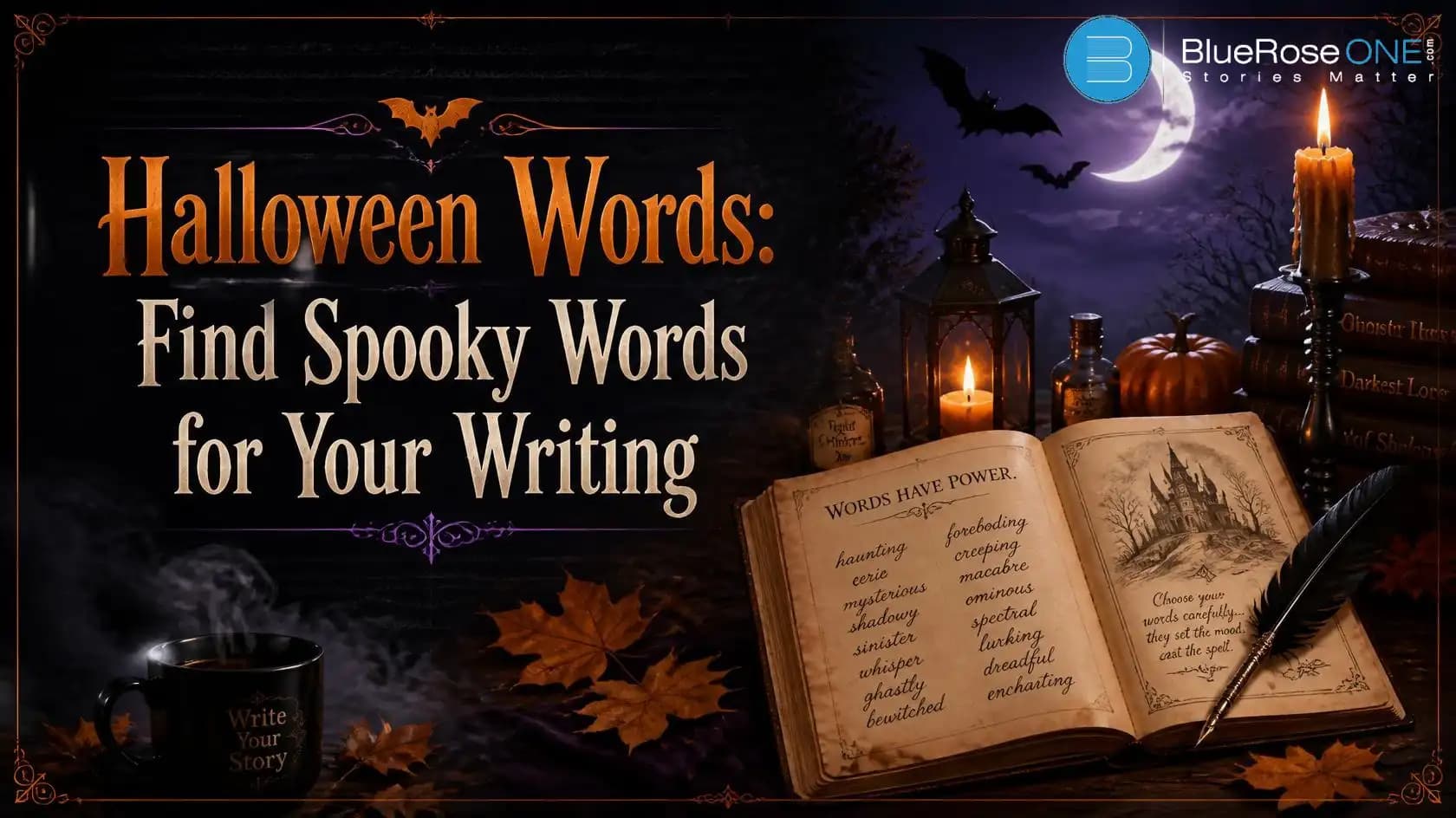
Halloween writing becomes much more vivid when you choose words that create an atmosphere rather than simply telling readers that something is “scary.” The right Halloween Words can make a dark forest feel threatening, a quiet house feel haunted, or an ordinary October night feel strangely magical.
Whether you are writing a horror story, fantasy novel, Halloween poem, classroom activity, social media caption, or seasonal blog post, this guide gives you a practical Halloween words list organized by mood and purpose.
You will find more than 150 words, descriptive terms, expressions, and Halloween phrases to help you write with greater atmosphere and originality.
Instead of filling every sentence with “scary,” you can choose words such as sinister, spectral, ominous, uncanny, or foreboding, and suddenly your writing has a completely different texture.
What Are Halloween Words?
Halloween Words are vocabulary associated with Halloween, including supernatural creatures, costumes, decorations, autumn imagery, emotions, actions, settings, traditions, and spooky descriptions.
Some are directly connected to the holiday, such as pumpkin, jack-o’-lantern, trick-or-treat, and candy corn. Others describe the atmosphere surrounding Halloween, such as eerie, shadowy, haunted, chilling, and mysterious.
Halloween vocabulary can therefore be divided into two broad groups:
- Thematic words: pumpkin, witch, vampire, skeleton, cemetery
- Atmospheric words: eerie, ominous, sinister, haunting, unsettling
This distinction matters for writers. A thematic word tells readers what is present; an atmospheric word helps them feel what is happening.
Halloween itself has a fascinating cultural history. The Library of Congress notes that the holiday developed through the blending of traditions associated with the ancient Celtic festival of Samhain and later Christian observances surrounding All Saints’ Day and All Souls’ Day.
That history explains why Halloween vocabulary includes such a broad mixture of folklore, religion, seasonal imagery, supernatural ideas, and modern popular culture.
150+ Halloween Words for Writing
Here is a carefully organized collection of Halloween vocabulary for writers, poets, readers, teachers, and anyone looking for the right spooky word.
Halloween Words for Spooky Atmosphere
Use these words when you want to establish tension, mystery, darkness, or unease:
- Eerie
- Spooky
- Sinister
- Haunting
- Chilling
- Creepy
- Unsettling
- Ominous
- Macabre
- Ghoulish
- Grisly
- Ghastly
- Frightening
- Terrifying
- Horrifying
- Bone-chilling
- Bloodcurdling
- Uncanny
- Foreboding
- Mysterious
- Supernatural
- Otherworldly
- Spectral
- Shadowy
- Nightmarish
- Menacing
- Sinful
- Wicked
- Bewitching
- Enchanted
Halloween Words for Darkness and Night
When your scene happens after sunset, these words can help create a stronger visual atmosphere:
- Midnight
- Moonlight
- Moonlit
- Darkness
- Shadow
- Gloom
- Twilight
- Dusk
- Nightfall
- Blackness
- Silhouette
- Fog
- Mist
- Haze
- Murk
- Obscurity
- Starlight
- Eclipse
- Nightshade
- Veil
Halloween Words for Creatures and Monsters
Add supernatural characters or mysterious beings to your stories with these Halloween terms:
- Witch
- Wizard
- Warlock
- Vampire
- Werewolf
- Ghost
- Phantom
- Specter
- Apparition
- Poltergeist
- Zombie
- Ghoul
- Goblin
- Monster
- Demon
- Devil
- Skeleton
- Banshee
- Mummy
- Bat
- Black cat
- Jack-o’-lantern
- Shape-shifter
- Grim Reaper
- Spirit
Halloween Words for Witches and Magic
For fantasy, witchcraft, and magical Halloween scenes, consider these words:
- Cauldron
- Broomstick
- Spell
- Potion
- Incantation
- Hex
- Curse
- Charm
- Sorcery
- Witchcraft
- Magic
- Enchantment
- Coven
- Wand
- Crystal ball
- Talisman
- Amulet
- Rune
- Ritual
- Conjure
Halloween Words for Haunted Places
A supernatural setting becomes more memorable when you choose specific location words rather than repeatedly calling it a “scary place.”
- Cemetery
- Graveyard
- Tomb
- Crypt
- Mausoleum
- Haunted house
- Abandoned mansion
- Haunted forest
- Dark alley
- Attic
- Dungeon
- Catacomb
- Grave
- Churchyard
- Abandoned asylum
- Old cabin
- Ruins
- Foggy street
- Forgotten village
- Hidden chamber
Halloween Words for Sounds
Sound is one of the most effective tools for horror writing because readers often imagine a threat before they see it.
- Cackle
- Scream
- Whisper
- Shriek
- Howl
- Groan
- Moan
- Rattle
- Creak
- Scrape
- Rustle
- Thud
- Bang
- Knock
- Squeak
- Whimper
- Hiss
- Growl
- Chatter
- Laughter
Halloween Words for Halloween Objects and Traditions
These are among the most recognizable holiday-related words:
- Pumpkin
- Jack-o’-lantern
- Candy
- Candy corn
- Costume
- Mask
- Trick-or-treat
- Bonfire
- Cobweb
- Spiderweb
- Spider
- Lantern
- Scarecrow
- Black candle
- Gravestone
- Coffin
- Skull
- Bones
- Fangs
- Cape
- Cloak
- Makeup
- Treat bag
- Haunted attraction
- Halloween party
Halloween Words by Mood
Not every Halloween story needs to be terrifying. Halloween can be playful, mysterious, magical, creepy, nostalgic, or genuinely horrifying.
Choosing vocabulary according to mood gives your writing a consistent emotional identity.
For a Scary Halloween Story
Use:
- Terrifying
- Bloodcurdling
- Horrifying
- Grisly
- Menacing
- Sinister
- Nightmarish
- Dread
- Panic
- Terror
- Screaming
- Trembling
- Chilling
- Horrific
- Deathly
Example:
The abandoned house stood beneath the moon, its broken windows staring into the darkness like hollow eyes.
For a Creepy Halloween Story
Creepy writing often works better when it is subtle rather than excessively violent.
Try:
- Eerie
- Uncanny
- Strange
- Whispering
- Shadowy
- Silent
- Unsettling
- Abandoned
- Watchful
- Hollow
- Faint
- Still
- Forgotten
- Unnatural
- Mysterious
Example:
Nothing moved in the hallway, yet she could feel someone watching from the darkness.
For a Magical Halloween Story
For fantasy or whimsical writing, choose:
- Enchanted
- Bewitching
- Mystical
- Magical
- Spellbound
- Moonlit
- Glittering
- Potion
- Charm
- Sorcery
- Stardust
- Wand
- Enchantment
- Cauldron
- Conjure
Example:
Under the silver moon, the old witch stirred a glowing potion that shimmered like captured starlight.
For a Fun Halloween Story
Halloween can also be playful and humorous:
- Boo
- Costume
- Candy
- Pumpkin
- Mischief
- Treat
- Prank
- Party
- Monster
- Goblin
- Spooky
- Silly
- Batty
- Witchy
- Creepy-cute
This vocabulary works especially well for children’s books, greeting cards, classroom activities, and lighthearted social media content.
Halloween S Words to Make Writing Spookier
If you specifically need Halloween S words, there are plenty of excellent choices.
Try these:
- Scare
- Scared
- Scary
- Screech
- Scream
- Shadow
- Shiver
- Shriek
- Skeleton
- Sinister
- Specter
- Spell
- Spider
- Spiderweb
- Spirit
- Spooky
- Supernatural
- Séance
- Skull
- Slither
- Silence
- Shadowy
- Strange
- Suspense
- Scream-inducing
Example Using Halloween S Words
Instead of writing:
The place was scary.
Try:
The silent staircase disappeared into shadow as a sinister whisper slipped through the stillness.
The second version creates an atmosphere rather than simply naming an emotion.
W Halloween Words for Halloween Writing
If you’re searching for W Halloween words, these are especially useful:
- Warlock
- Werewolf
- Wicked
- Witch
- Witchcraft
- Whisper
- Whimper
- Wail
- Wand
- Wraith
- Web
- Wind
- Willow
- Wax
- Wolf
- Wandering
- Watchful
- Weird
- Wickedness
- Wisp
Writer’s tip: Words beginning with the same letter can be useful for poetry, children’s activities, alphabet-based Halloween worksheets, and creative writing prompts.
Halloween Phrases for Stories, Captions, and Poems
Sometimes a single word isn’t enough. A well-chosen phrase can immediately establish a Halloween mood.
Here are useful Halloween phrases:
- All Hallows’ Eve
- Trick or treat
- Happy Halloween
- Beware the night
- Something wicked this way comes
- Shadows in the moonlight
- A chill in the air
- Whispers in the dark
- The witching hour
- A house of horrors
- Dance with the dead
- Ghosts in the graveyard
- Under a blood-red moon
- Lost in the fog
- Beyond the veil
- A night of fright
- Enter if you dare
- The dead walk tonight
- Spirits of the night
- Shadows came alive
- A haunting silence
- A cursed place
- The forgotten grave
- The door creaked open
- A whisper from beyond
- Something lurked nearby
- The moon watched silently
- Darkness swallowed the road
- A scream broke the silence
- The forest came alive
The Library of Congress documents familiar Halloween traditions such as costumes, ghosts, trick-or-treating, pumpkin carving, and Halloween storytelling, making these concepts useful foundations for seasonal writing.
How to Use Halloween Words in Creative Writing
A long vocabulary list is useful, but knowing how to use the words is what actually improves your writing.
1. Replace Generic Adjectives
Avoid relying on words such as:
- Scary
- Creepy
- Dark
- Weird
- Strange
These aren’t wrong, but they are broad.
Instead of:
It was a scary house.
Write:
The abandoned Victorian house loomed beneath the fog, its boarded windows glowing faintly in the moonlight.
Specific details create stronger imagery.
2. Combine Sight, Sound, Smell, and Touch
Effective Halloween writing uses more than visual descriptions.
For example:
The candle sputtered. A damp smell rose from the basement. Somewhere behind the wall, something scratched.
Notice how the scene uses sound, smell, sight, and uncertainty.
That uncertainty is important. You don’t always need to reveal the monster. Sometimes the possibility of one is scarier.
3. Use Verbs Instead of Adjective Piles
Weak:
The extremely scary, creepy, dark hallway was frightening.
Stronger:
The hallway narrowed as she crept forward. Shadows crawled across the walls, and something scratched beneath the floorboards.
The second version creates movement and tension.
4. Choose Words That Match Your Genre
The best Halloween vocabulary depends on the type of story you’re writing.
| Genre | Useful Vocabulary |
| Horror | dread, terror, bloodcurdling, sinister |
| Mystery | clue, secret, shadow, suspicious |
| Fantasy | enchantment, spell, potion, magical |
| Romance | moonlit, bewitching, mysterious |
| Children’s fiction | pumpkin, costume, goblin, candy |
| Gothic fiction | crypt, melancholy, spectral, decaying |
| Thriller | threat, pursuit, warning, panic |
| Comedy | goofy, mischievous, batty, silly |
This is where many generic all Halloween words lists fall short: they give you vocabulary without explaining when each word actually works.
How to Make Halloween Descriptions More Original
One of the easiest ways to improve spooky writing is to stop describing everything as “dark.”
Compare:
Basic:
The forest was dark and scary.
More atmospheric:
Fog curled between the trees, swallowing the moonlight one branch at a time.
The second description doesn’t even use the word scary. Yet it creates a stronger feeling.
Try these techniques:
Use Unexpected Comparisons: The moon hung above the cemetery like a watchful eye.
Give the Setting Human Qualities: The abandoned house seemed to hold its breath.
Use Contrasts: The children’s laughter echoed through the empty cemetery.
Hide the Threat: The door was open when she returned. She was certain she’d locked it.
Focus on Small Details: A single muddy footprint appeared beside her bed.
Small details often create more suspense than enormous monsters.
Halloween Words for Different Types of Writing
For Horror Novels
Prioritize words that create dread:
Dread, ominous, claustrophobic, decaying, grotesque, spectral, sinister, lurking, cursed, malevolent.
Pair these with sensory details and carefully controlled pacing.
For Halloween Poems
Poetry benefits from rhythm, sound, imagery, and repetition.
Try:
Moonlight, whisper, shadow, raven, candle, mist, midnight, graveyard, autumn, crimson, silence, spirit.
Alliteration can also make a line more memorable:
Silent shadows slipped beneath the silver sky.
For Children’s Stories
Choose playful vocabulary:
Pumpkin, costume, candy, monster, witch, broomstick, bat, ghost, goblin, spell, magic, boo, trick, treat.
Keep frightening elements age-appropriate and balance suspense with humor.
For Social Media Captions
Short phrases work best:
- Spooky season is here.
- Boo-tiful night!
- Witchy vibes only.
- Enter if you dare.
- Feeling fang-tastic.
- Something wicked is brewing.
- Meet me under the moonlight.
- A little magic, a little mischief.
- Keep calm and haunt on.
- Trick or treat yourself.
How to Avoid Repetitive Halloween Writing
A common problem with seasonal writing is repetition.
If every paragraph contains ghost, scary, dark, and Halloween, your prose can quickly become predictable.
Instead, build a semantic field around your scene.
For a haunted cemetery, you might use:
Environment:
mist, headstones, iron gate, weeds, moonlight
Movement:
crept, drifted, wandered, emerged, vanished
Sound:
whisper, rustle, groan, crack, howl
Emotion:
dread, suspicion, anxiety, panic
Supernatural:
specter, apparition, spirit, curse
Now you can create an atmosphere without repeatedly saying “haunted.”
For additional character-building guidance, BlueRose’s guide to character flaws explains how fear, arrogance, impulsiveness, and other flaws can shape believable characters.
Halloween Vocabulary: Words vs. Phrases vs. Descriptions
Understanding the difference can help you select vocabulary more strategically.
Halloween word:
Specter
Halloween phrase:
A specter in the hallway
Descriptive sentence:
A pale specter drifted silently through the hallway.
Atmospheric passage:
The hallway was silent until a pale figure appeared at the far end. It did not walk. It simply drifted closer.
Each level adds context.
For writers, the goal isn’t to use as many Halloween words as possible. The goal is to choose the one word that does the most work.
Conclusion
The best Halloween writing isn’t simply packed with ghosts, witches, pumpkins, and monsters. It creates an atmosphere that makes readers feel the cold air, hear the distant footsteps, notice the strange shadow, and wonder what is waiting around the corner.
Use this Halloween words list as a creative toolbox rather than a checklist. Choose vocabulary based on your genre, mood, character, and setting. Mix familiar Halloween terms with precise sensory language, strong verbs, and unexpected imagery.
And remember: the most frightening sentence isn’t always the one that says “Something scary appeared.” Sometimes it’s the one that quietly says:
The front door was already open.
If you’re ready to turn those spooky ideas into a compelling story, explore more BlueRose writing resources, experiment with atmosphere and suspense, and let your imagination take the lead. Your next unforgettable Halloween story might be only a few haunting words away.



0 Comments