
Scary Books for Adults: Find Your Next Chilling Read

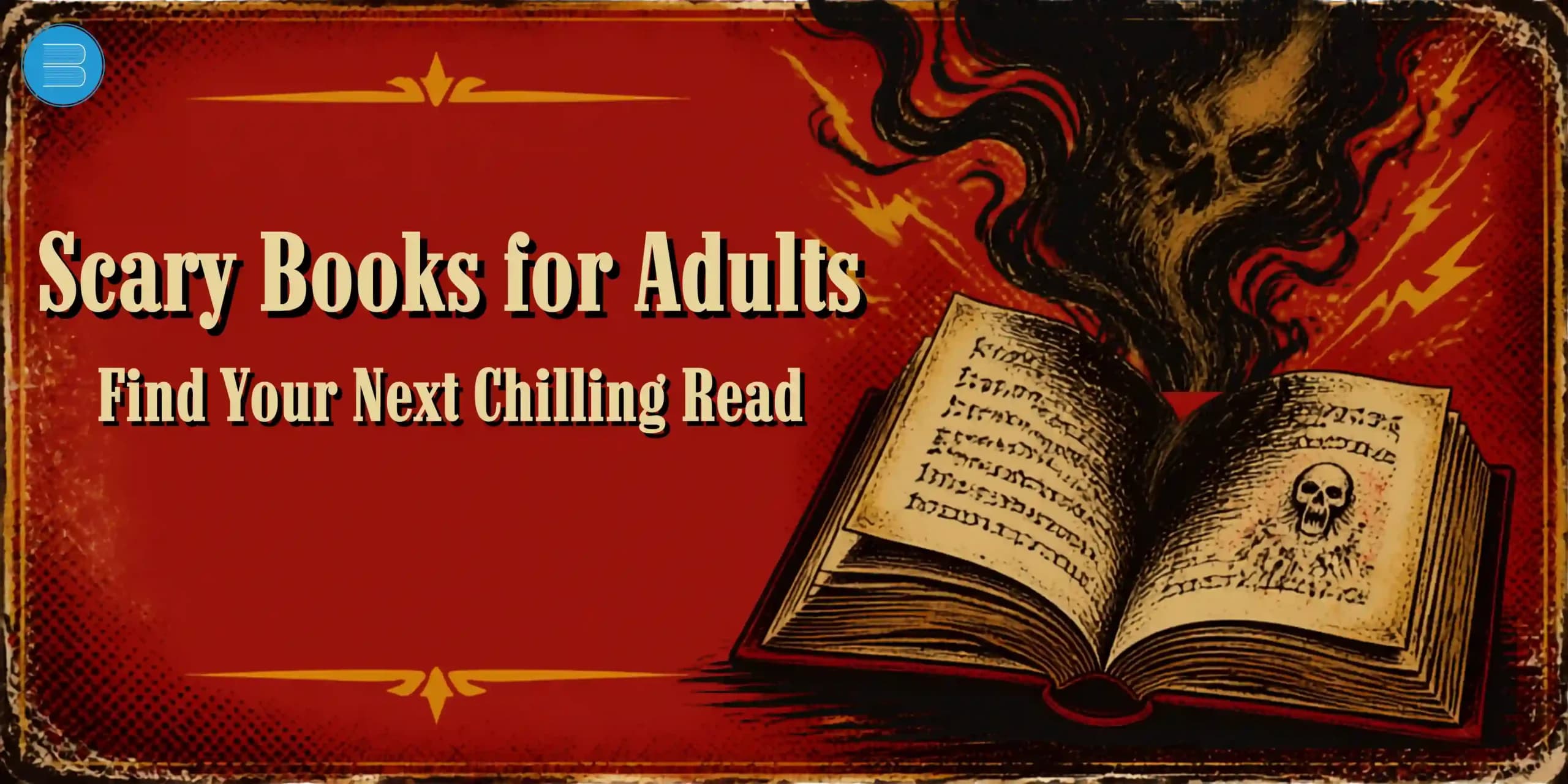
Looking for Scary Books for Adults that do more than throw a predictable monster into the shadows? The best horror novels create a different kind of fear, one that follows you after you close the book.
A strange sound at night suddenly feels suspicious, an empty hallway looks different, and your imagination starts finishing the story for you.
This list brings together ten genuinely chilling novels across supernatural horror, psychological terror, Gothic fiction, body horror, survival horror, and literary horror.
Rather than ranking books only by gore or shock value, the selections consider atmosphere, psychological tension, originality, emotional impact, and the ability to leave a lasting impression.
Whether you want a classic haunted-house story, a claustrophobic psychological nightmare, or something modern and deeply unsettling, there is a nightmare here waiting for you.
You may also like: Literary Horror Books | Horror That Stays With You
What Makes a Book Truly Scary for Adults?
Fear changes as readers grow older. A child might fear a monster under the bed, while an adult may find isolation, grief, obsession, losing control, or the breakdown of reality much more disturbing.
That is why effective adult horror often works on several levels.
1. Psychological tension
Psychological horror makes readers question what is real. Unreliable narrators, paranoia, obsession, manipulation, and deteriorating mental states can make the reader feel trapped inside a character’s mind.
2. Atmosphere
A talented horror writer knows that an empty house can be more frightening than a visible monster. Darkness, silence, isolation, strange architecture, and ominous weather can gradually build dread.
3. Emotional stakes
The most memorable horror stories give readers something to lose. Family, identity, love, safety, sanity, and freedom can all become sources of fear.
4. The unknown
What readers cannot see is often scarier than what they can. Horror becomes particularly effective when a story withholds information and lets the reader’s imagination fill the gaps.
BlueRose’s guide to literary horror books similarly highlights atmosphere, psychology, symbolism, and deeper themes as important elements that distinguish literary horror from simple shock-driven fiction.
You may also like: Best Cosmic Horror Books: Modern Hits & Classics!
Top 10 Scary Books for Adults
1. The Exorcist by William Peter Blatty
If supernatural horror is your weakness, The Exorcist is an obvious place to begin.
Published in 1971, William Peter Blatty’s novel centers on a young girl whose behavior becomes increasingly disturbing as her mother seeks answers. What begins as a frightening mystery develops into a battle involving faith, medicine, family, and an apparently supernatural force.
What makes the novel frightening isn’t simply the possession itself. Blatty builds tension by placing extraordinary evil inside an ordinary family environment.
Why it is scary: Supernatural horror, religious dread, helplessness, psychological tension.
Best for: Readers who want classic, intense supernatural horror.
Scare factor: 5/5
2. The Haunting of Hill House by Shirley Jackson
Some haunted-house stories rely on ghosts appearing at convenient moments. Shirley Jackson’s The Haunting of Hill House takes a much subtler approach.
The story follows Eleanor Vance as she joins a small group investigating the mysterious Hill House. As strange events unfold, the distinction between supernatural activity and psychological instability becomes increasingly difficult to establish.
That uncertainty is precisely what makes the novel so unsettling.
You are never completely sure whether the house is haunted, whether Eleanor is unraveling, or whether the two possibilities are somehow connected.
Why it is scary: Psychological uncertainty, isolation, atmosphere, unreliable perception.
Best for: Readers who prefer slow-burn horror over gore.
Scare factor: 5/5
3. The Shining by Stephen King
Stephen King’s The Shining is proof that isolation can be terrifying.
Jack Torrance accepts a winter caretaker position at the remote Overlook Hotel, taking his wife and young son with him. Once the family becomes isolated by the winter weather, the hotel’s disturbing history begins to surface.
But the supernatural elements are only part of the horror. Jack’s personal struggles and gradual psychological deterioration create an even more frightening threat.
The result is a story where the setting, character, and supernatural forces work together.
Why it is scary: Isolation, supernatural horror, psychological deterioration, family danger.
Best for: First-time Stephen King readers and fans of haunted locations.
Scare factor: 5/5
4. Pet Sematary by Stephen King
If grief scares you more than ghosts, Pet Sematary may be the book for you.
The novel follows Louis Creed and his family after they move to a seemingly peaceful rural home. Nearby lies an old burial ground and beyond it, something far more sinister.
King uses grief as the story’s emotional engine. The central question is horrifyingly simple: What if you could bring someone you loved back?
The terror comes from understanding that getting what you desperately want may be much worse than losing it.
Why it is scary: Death, grief, resurrection, family, supernatural consequences.
Best for: Readers who want emotionally devastating horror.
Scare factor: 5/5
5. Misery by Stephen King
You do not need ghosts, demons, or monsters to create a nightmare. Sometimes one terrifying person is enough.
In Misery, novelist Paul Sheldon survives a serious accident only to wake up in the isolated home of Annie Wilkes, an obsessive fan. Annie claims to love his writing, but her affection quickly becomes something much darker.
The brilliance of Misery lies in its claustrophobia. Paul cannot simply walk away. His physical vulnerability makes every conversation dangerous.
For adult readers, the story’s horror comes from losing autonomy and realizing that the person supposedly helping you may control every aspect of your survival.
Why it is scary: Obsession, captivity, manipulation, helplessness.
Best for: Readers who prefer psychological thrillers with horror elements.
Scare factor: 4.5/5
You may also like: Best Horror Books That Will Keep You Up All Night
You may also read: What Is Literary Horror? 15 Must-Read Books & Definition (2026 Guide)
6. It by Stephen King
Few horror villains have become as culturally recognizable as Pennywise, the terrifying entity at the center of It.
But the novel is about much more than a frightening clown. It explores childhood fears, friendship, memory, trauma, and the way unresolved terror can follow people into adulthood.
A particularly effective feature of It is the contrast between childhood vulnerability and adult responsibility. The characters must eventually confront something they thought they had escaped.
That makes the story work as both supernatural horror and a meditation on memory.
Why it is scary: Shape-shifting evil, childhood fears, trauma, friendship, supernatural terror.
Best for: Readers who enjoy long, immersive horror novels.
Scare factor: 5/5
7. House of Leaves by Mark Z. Danielewski
Want something genuinely strange?
Try House of Leaves.
The novel centers on a house whose interior appears to be larger than its exterior. From there, Danielewski builds a labyrinthine story involving multiple narrators, footnotes, documents, and unusual typography.
The physical structure of the book becomes part of its horror. The reader isn’t merely told that the characters are becoming disoriented, the layout itself can make the reading experience feel disorienting.
It is an excellent choice for adults who enjoy experimental literature and want horror that challenges the traditional boundaries of a novel.
Why it is scary: Impossible architecture, psychological instability, uncertainty, experimental storytelling.
Best for: Literary readers and writers interested in unconventional narrative techniques.
Scare factor: 4.5/5
House of Leaves is also discussed as a defining example of experimental literary horror.
8. Bird Box by Josh Malerman
Imagine living in a world where looking outside could cost you your sanity or your life.
That is the terrifying premise of Josh Malerman’s Bird Box.
The novel follows Malorie as she attempts to survive in a world where mysterious entities cause people who see them to become dangerously violent or mentally unstable.
The result is a story built around sensory deprivation. Characters must move through the world without relying on their eyes, turning ordinary activities into terrifying challenges.
A trip outside isn’t simply a trip outside. Opening a window becomes a risk. Hearing footsteps becomes terrifying.
Why it is scary: The unseen, sensory deprivation, survival, paranoia.
Best for: Readers who love fast-paced modern horror.
Scare factor: 4.5/5
9. Mexican Gothic by Silvia Moreno-Garcia
For readers who want Gothic horror with atmosphere, history, and social commentary, Mexican Gothic is an excellent choice.
Noemí Taboada travels to a remote mansion in 1950s Mexico after receiving a disturbing message from her cousin. What she discovers there becomes increasingly strange and sinister.
The novel combines Gothic conventions with themes of power, colonialism, family control, and identity.
Its greatest strength is atmosphere. The house feels alive, oppressive, and increasingly difficult to escape.
Why it is scary: Gothic horror, isolation, family secrets, psychological manipulation.
Best for: Readers who want horror with historical and cultural depth.
Scare factor: 4.5/5
10. The Only Good Indians by Stephen Graham Jones
If you’re looking for something more contemporary, Stephen Graham Jones’s The Only Good Indians offers a striking blend of psychological, supernatural, and cultural horror.
The story follows four Blackfeet men whose past actions during a hunting trip come back to haunt them years later.
Rather than relying exclusively on traditional monsters, Jones builds horror around guilt, memory, identity, community, and consequences.
The novel is especially interesting for writers because its structure demonstrates how a past event can become the central engine of a horror narrative.
Why it is scary: Guilt, supernatural revenge, identity, cultural tension, psychological dread.
Best for: Experienced horror readers searching for something different.
Scare factor: 4.5/5
Scary Books for Adults vs. Children’s Halloween Books
Search results around Halloween often mix adult horror with children’s recommendations. That can make it difficult to find genuinely frightening books for mature readers.
For example, Five Little Pumpkins is associated with the familiar Halloween nursery-rhyme tradition and is much better suited to younger audiences than adults seeking serious horror.
Likewise, searches for the best Halloween picture books are useful if you’re choosing books for children, classrooms, or family reading, but they shouldn’t be confused with adult horror recommendations.
Adults searching for good scary books to read generally have a much wider range of options, from psychological thrillers to extreme horror and literary Gothic fiction.
There is also an interesting middle ground for readers who enjoy relationships alongside darkness. Searches for spooky romance books can lead to Gothic romance, paranormal romance, romantic suspense, and dark romance, genres that combine emotional relationships with supernatural or threatening elements.
The key is knowing what kind of reading experience you actually want.
How to Make Your Horror Reading Experience Even Scarier
A good horror novel doesn’t need special effects. Your reading environment can do some of the work.
1. Read at night: Darkness naturally limits what you can see, making atmospheric horror more immersive.
2. Put your phone away: Constant notifications break tension. Give the story your complete attention.
3. Use a comfortable but isolated reading space: A quiet room can make subtle sounds feel surprisingly significant.
4. Don’t immediately research the ending: Horror relies heavily on uncertainty. Spoilers can eliminate much of the tension.
5. Read slowlyYou don’t have to race through frightening scenes. Pay attention to imagery, sound, setting, and foreshadowing.
6. Keep a reading journal: For writers especially, horror novels are excellent opportunities to study pacing, character vulnerability, suspense, sensory description, and narrative reveals.
The National Endowment for the Arts has also highlighted the broader value of reading, including its relationship with intellectual engagement and reading comprehension.
Final Thoughts
The best Scary Books for Adults do much more than frighten you for a few hours. They create characters you care about, worlds you don’t want to enter, and questions you can’t stop thinking about.
If you want supernatural terror, start with The Exorcist. For psychological dread, try Misery. If haunted houses are your weakness, choose The Haunting of Hill House. For something experimental, pick up House of Leaves. And if you want a modern Gothic atmosphere, Mexican Gothic is a compelling choice.
Don’t worry about finding the universally “scariest” book. Find the kind of fear that works on you.
Turn down the lights, choose your book, and start reading, but don’t blame the story when every noise in the house suddenly sounds suspicious.
Ready for another nightmare? Explore more horror recommendations from BlueRose and discover the book that will keep you turning pages long after midnight.
0 Comments