
How Many Books Should You Read in a Year? Read Smarter

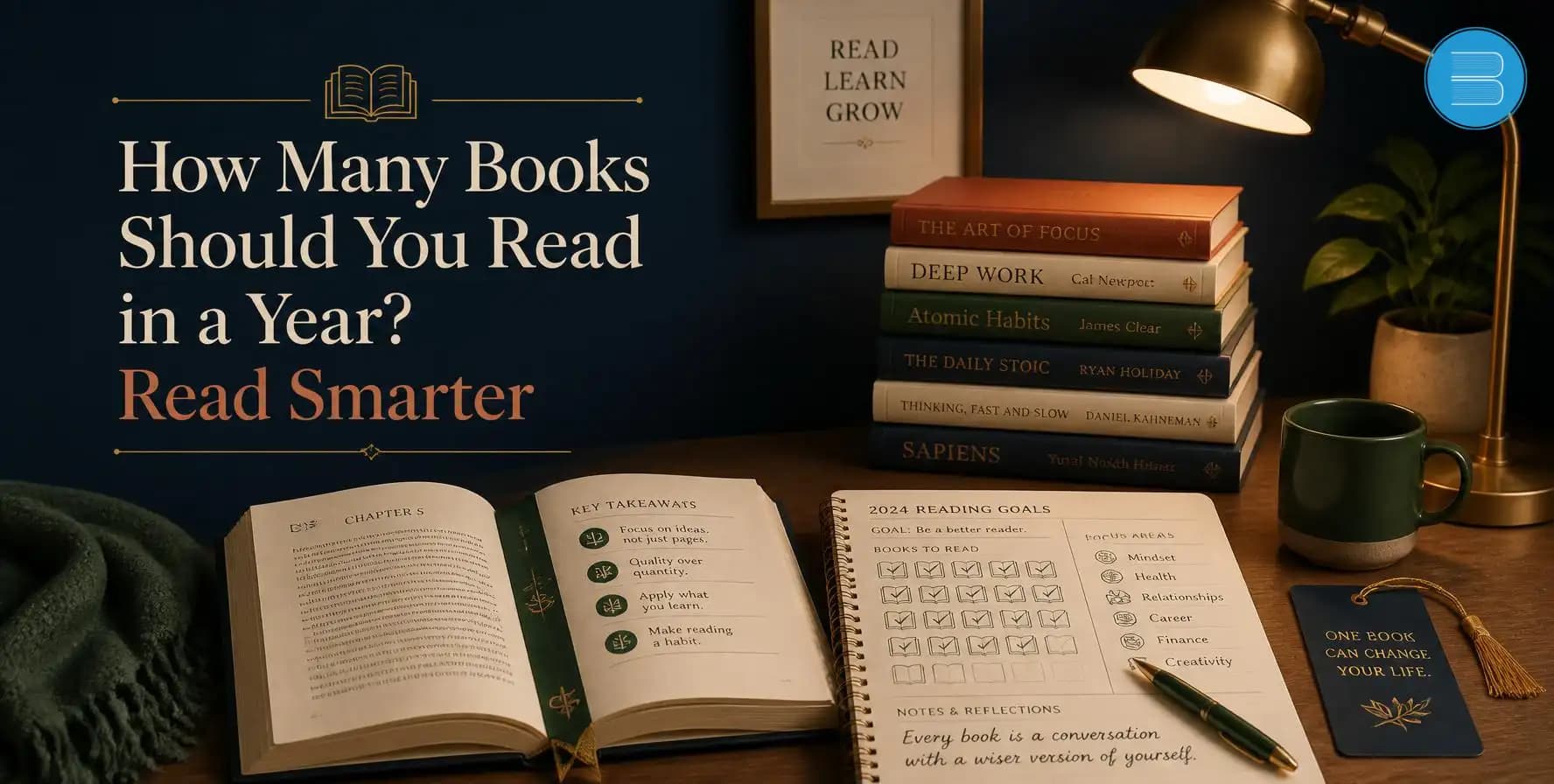
If you have ever asked yourself the question of How Many Books Should You Read in a Year, then you’re definitely not alone. Maybe you saw people posting on their blogs or Facebook about reading 50, 75 or even 100 books and wondered if you were lagging behind? Or maybe you would like to read more but don’t know what number fits for you.
The fact is that there is no such magic number that everyone should read per year. Instead you should set a goal according to your schedule, interests, reading speed and purpose of reading.
It can be 12 books for one person a year or 50 or 100 for another person and if you read only three truly important books per year, then it’s OK too.
In this guide you will learn how to set yourself a realistic goal for reading for the year, what the meaning of those numbers is and most importantly how to read smarter rather than just more.
Table of Content
- How Many Books Should You Read in a Year?
- How Many Books a Year Should You Read? Look at Time, Not Just Numbers
- How Many Books You Should Read a Year Depends on Your Goal
- If You’re a Writer or Author
- If You’re a Poet
- What Is the Average Number of Books People Read?
- Why does the distinction between the average and the median matters?
- Why Reading More Isn't Always Reading Better
- Read Smarter: 7 Ways to Get More From Your Books
- Does Reading More Books Make You Smarter?
- Conclusion: Read More, But Read Smarter
How Many Books Should You Read in a Year?
For most adult readers, a practical starting target is 12 books per year, or approximately one book each month.
However, your ideal number depends on several factors:
- How much free time you have
- Your average reading speed
- The length and difficulty of your books
- Whether you read fiction, nonfiction, poetry, or academic material
- Whether you use print books, e-books, audiobooks, or a combination
- Your purpose for reading
- How deeply you want to engage with each book
Instead of asking, “How many books should I read?” ask:
“How much meaningful reading can I consistently fit into my life?”
That small change in perspective makes an annual reading goal much more sustainable.
A Simple Annual Reading Goal Chart
| Reading Level | Annual Goal | Approx. Monthly Goal |
| Casual reader | 1–6 books | 1 book every 2–12 months |
| Beginner | 12 books | 1 book |
| Consistent reader | 24 books | 2 books |
| Serious reader | 36 books | 3 books |
| Avid reader | 50–52 books | About 1 per week |
| Very fast/committed reader | 75–100+ books | 6–8+ per month |
These numbers are not rules. They are just useful guidelines.
An individual who is going through 12 difficult books of philosophy will certainly take much longer to read than one reading 30 novels.
You may also like: Motivational Books for Men to Build a Stronger Mindset
How Many Books a Year Should You Read? Look at Time, Not Just Numbers
One of the biggest mistakes people make when setting reading goals is focusing exclusively on the number of books.
A book is not a standardized unit of reading.
A 100-page poetry collection and an 800-page historical novel both count as one book, but they demand very different amounts of time and attention.
That’s why reading time can be a better metric than book count.
Try a Daily Reading Target
For example, suppose you read for:
- 15 minutes a day → about 91 hours per year
- 30 minutes a day → about 183 hours per year
- 45 minutes a day → about 274 hours per year
- 60 minutes a day → about 365 hours per year
In just twenty minutes each day, one can make a significant reading habit throughout the year.
If one can read an average of about 30 pages per hour and read for 30 minutes daily, one would be able to read 9,000 pages in a year.
This may vary depending on how long the books are but will probably amount to about 25-35 books.
The point is not so much on getting a certain exact number; it is on being consistent.
Reading Goal Equation
One can come up with an approximate equation as:
Books per year ≈ (daily reading time minutes × 365 × pages per minute) ÷ average book length
It does not have to be calculated very precisely; just to give you a goal based on your own lifestyle.
How Many Books You Should Read a Year Depends on Your Goal
Your perfect reading goal would vary significantly based on your reasons for reading.
The novelist, the university student, the leisurely fiction reader, the poet, and the business person would all need radically different reading programs. When You Read for Entertainment Your goal will be pleasure.
Ten entertaining novels are better than making yourself slog through forty books that you do not find enjoyable. Think about setting a goal of:
12-24 books per year
This would be enough to develop a routine of reading without making it a chore. When You Read for Self-Improvement The non-fiction books often need more thought than the fiction books. You could choose to read:
12-24 well-chosen books per year
Not reading book after book but rather making notes, revisiting interesting parts, and applying the knowledge.
One such self-improvement book that alters your habits is worth far more than ten books that you cannot recall.
You may also like: 10 Best Audiobook Apps to Find Books Worth Listening To
You may also read: Christmas Books to Read This Holiday Season – Explore
If You’re a Writer or Author
If you’re a writer or author, you shouldn’t just read often; you should usually read widely. One goal you might aim for each year would be:
Between 24–50 books a year, based on your available time.
Books you might choose to read include:
- Contemporary fiction
- Literary classics
- Books in your genre
- Poetry
- Essays
- Memoirs
- Narrative nonfiction
- Books about writing
- Books from other cultures and perspectives
Variety is just as important for writers as quantity.
Reading across genres may expose you to new narrative structures, voices, metaphors, characters, and ways of telling a story.
If You’re a Poet
Poetry benefits from rereading.
You’ll read fewer books but you’ll revisit individual poems numerous times. One book can take weeks as you analyze rhythm, imagery, line breaks, sound, metaphor, and emotion.
As a poet, 12–30 collections or poetry-related books a year can mean more than reading many books.
You may also read: Top 5 Reading Before Bed: Build a Calmer Nighttime Routine
What Is the Average Number of Books People Read?
Statistics can help us put things into context, but we mustn’t let them turn into a competition.
According to Pew Research Center’s October 2025 survey, 75% of American adults read some part of at least one book in the last 12 months.
Among adults reading books, there was a high variation in the volume of their reading; 38% read one to five books, 13% read six to 10 books, 10% read 11 to 20, and 14% read more than 20. On the other hand, 25% did not read any books.
As for Pew’s research conducted in 2021, on average an American reader had read around 14 books, with the median being five books during the previous 12 months.
Why does the distinction between the average and the median matters?
An average can be heavily influenced by just a few highly frequent readers. The median shows what’s right in the middle of the distribution.
Thus, when asking “How many books a year should you read compared with everyone else?”, the answer is – don’t stress about comparing yourself.
Why Reading More Isn’t Always Reading Better
It is very easy for modern-day reading to degenerate into a numerical game.
Reading apps, social media, reading challenges, annual statistics, and community sites can create the impression that one must keep raising the number of books they read. But speed does not equal comprehension. Consider two readers.
Reader A reads 60 books but barely retains anything from the majority of those books.
Reader B reads 15 books, makes notes, discusses, reviews key passages, and incorporates several of the ideas into his/her own life.
Which reader got more out of it? There is no reason for the first one to get the advantage here.
Reading, ideally, should yield some result other than a number in your app: an idea, feeling, question, perspective, skill, story, or connection.
You may also like: Books for Stress Relief: Read Your Way to a Calmer Mind
Read Smarter: 7 Ways to Get More From Your Books
For reading more but not having to sacrifice enjoyment and comprehension, it’s important to enhance your reading system.
1. Have Your Next Book Picked Before You Need It
Don’t choose your next book when you’ve just finished your last one. Always maintain a reading list including:
- Books that you’ve bought already
- Book recommendations by reliable readers
- Classic books you want to read
- New book releases of your favorite genre
- Books on your current interests
Knowing what your next book will be helps you avoid the extra step of making decisions.
2. Read in Various Formats
Not all books have to be read in their printed form. Today’s readers can enjoy:
- Printed books
- E-books
- Audiobooks
According to Pew Research Center’s 2025 study, 64% of U.S. adults have read a printed book, 31% of them have read an e-book, and 26% have listened to an audiobook in the past year.
Audiobooks may come in handy when commuting, walking, exercising, cooking, and performing household chores.
3. Do Not Read Books That You Do Not Like
This could be the most liberating reading practice you will ever adopt. Simply because you started a book does not mean that you should keep reading it.
Even if you have read 100 pages of the book and find no interest in it, you should try stopping. Your goal for the year should not compel you to read and spend ten hours on something you do not like at all.
The 50-page rule is what you can adopt:
Give the book around 50 pages and if you still do not like it, then stop reading it.
4. Alternate Challenging and Non-Challenging Books
Reading several challenging books one after another leads to burnout.
It is a better idea to switch between the two.
Here is an example:
- Literary fiction
- Mystery
- Non-fiction
- Poetry
- Thriller
5. Read in Short Sittings
It doesn’t have to be two hours without interruptions.
Try:
- 10 minutes upon waking up
- 15 minutes at lunch time
- 20 minutes at night
- 30 minutes commuting on the way with an audiobook
Short sittings add up.
The purpose isn’t to create an ideal reading atmosphere; the purpose is to make reading convenient enough for you to actually read.
6. Apply Active Reading Skills
For the books which really matter to you, engage yourself in the content.
Ask:
- What is the message of the author?
- What proves the claim?
- What amazed me?
- What do I oppose?
- How is it related to another book?
- What can I use?
Similarly, BlueRose’s tips on reading recommend active reading, taking notes, variety of reading materials, and involvement in reading clubs.
7. Maintain a Reading Journal
Just reading a journal may change your attitude towards books.
Once you finish a book, write the following:
- Book:
- Rating:
- Best idea:
- Best quote:
- What did I learn?
- Would I recommend it? Why?
No need to write a big review.
Just five minutes of thought will help you remember a book much better.
You may also like: 100+ Transition Words & Phrases: Improve Your Writing Skills
You may also read: 10 Mistakes First-Time Authors Make: Publish with Confidence
Does Reading More Books Make You Smarter?
Reading is a form of activity that helps in learning, vocabulary building, comprehension, taking perspectives and mental engagement, but saying that more reading will make you smarter will not be fair.
Quality, comprehension, reflection and consistency are essential.
Research also shows that there is more value in reading than we think of. A 2025 Realist Review, involving 43 studies, identified several ways through which pleasure reading might facilitate wellbeing: these are relaxation, taking perspectives, intellectual stimulation, self-awareness, empathy and connectedness.
There have been some associations between pleasure reading and cognitive functioning and mental well-being among young readers, but one must not think that the number of books read annually will give a particular cognitive advantage.
The message is clear:
Keep reading, keep reflecting and keep choosing challenging books.
You may also read: Paranormal Romance Books: Find Your Next Dark Escape
You may also like: Mark Minervini Books: Learn His Trading Strategies & Ideas
Conclusion: Read More, But Read Smarter
So how many books do you need to read per year?
Well, for most people 12 is a good starting point. If you have more time to dedicate and actually enjoy reading then 24, 36, 50 or even 100 books are totally possible. But the best reading goal of the year isn’t always the highest number.
It’s the number that helps you to read consistently, learn something new, enjoy stories, sharpen your mind and remember what you’ve read.
Forget about the numbers and statistics. Read different genres. Listen to audiobooks. Drop books that don’t do anything useful for you. Reread important books. Write down any thoughts that pop up while reading. And if you are a writer, use your reading as your education.
So instead of aiming at “reading 100 books per year,” you could just aim at:
Reading one good book next time.
Another one after that.
And yet another one.
You’ll be amazed how far you’ll go by the end of the year.


0 Comments