
100+ Transition Words & Phrases: Improve Your Writing Skills

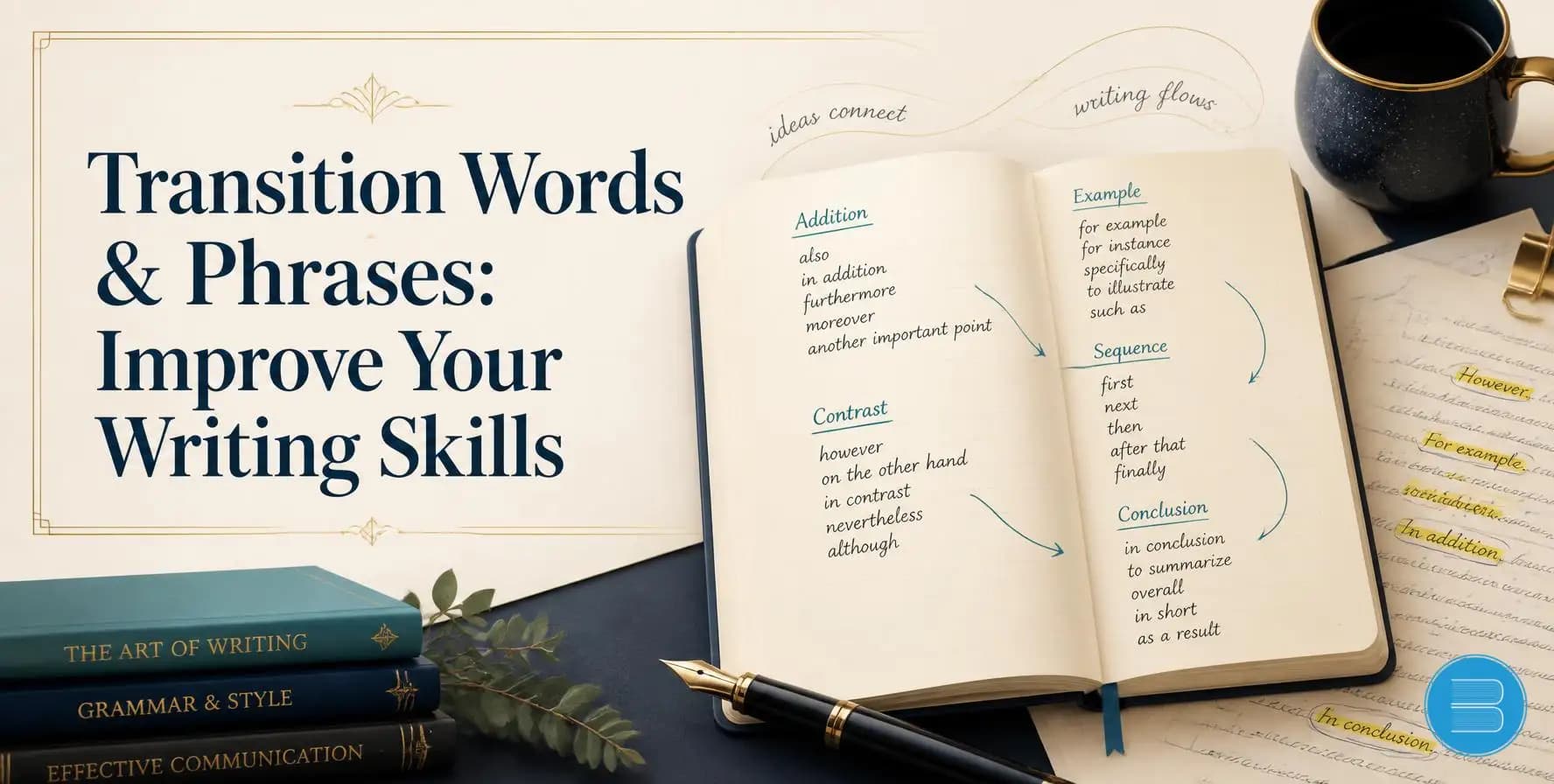
Clear writing isn’t just about choosing brilliant words; it’s about building bridges between them. If your prose feels jerky or disconnected, transition words are the glue that holds your thoughts together.
Whether you are writing an essay, drafting a novel, or composing poetry, mastering these connective elements ensures your readers follow your train of thought effortlessly.
You may also like: Paranormal Romance Books: Find Your Next Dark Escape
You may also read: Books for Stress Relief: Read Your Way to a Calmer Mind
Table of Content
What Are Transition Words and Why Do They Matter?
Transition words and their multi-word counterparts, transitional phrases, are signposts for your reader. They indicate relationships between sentences and paragraphs, signalling whether you are adding information, contrasting ideas, showing cause and effect, or concluding an argument.
Without effective transition terms, even the most insightful ideas can feel scattered.
[Isolated Idea A]  --->  (Transition Word)  --->  [Isolated Idea B]
                                 │
                   Creates Smooth Logical Flow
By establishing clear logical relationships, transitions strengthen the structural integrity of your writing.
How Transitions Work: Sentences vs. Paragraphs
To use transition words effectively, you must understand their scope. They operate at two primary levels: within individual sentences and between entire paragraphs.
Transition Words for Paragraphs
When moving from one major point to another, paragraph-level transitions guide the reader through your broader narrative arc.
Example: Paragraph 1 concludes discussing the benefits of morning routines. Paragraph 2 begins: Equally important, however, is how one structures the final hours of the evening…
Transition Words for Essays and Long-Form Pieces
Academic and analytical writing relies heavily on good transition words to build persuasive arguments step-by-step.
Example: The experimental data initially suggested a simple linear correlation. On closer inspection, nevertheless, the presence of secondary variables revealed a far more complex system.
You may also like: Mark Minervini Books: Learn His Trading Strategies & Ideas
You may also read: Inspirational Writing Quotes to Spark Your Creativity
You may also like: Central Idea in Literature: Find Meaning with Examples
The Ultimate List: 100+ Transition Words & Phrases
Here is your comprehensive transitions list, categorized by logical function to help you find the exact phrase you need.
1. Addition & Agreement
Use these terms when building on a previous point or adding supporting evidence.
- Additionally
- Furthermore
- Moreover
- In addition to
- Coupled with
- Not only… but also
- Likewise
- Correspondingly
- As well as
- Together with
2. Contrast & Disagreement
Use these terms to introduce opposing views, shifts in perspective, or counter-arguments.
- However
- On the other hand
- Conversely
- Nevertheless
- Nonetheless
- In contrast
- On the contrary
- Despite this
- Be that as it may
- Alternatively
3. Cause, Purpose & Condition
Use these phrases to illustrate reason, intent, or specific dependencies between ideas.
- Consequently
- Therefore
- As a result
- For this reason
- Provided that
- In order to
- Owing to
- In light of
- Assuming that
- On the condition that
4. Sequence, Time & Order
Use these terms to organize chronological events or structure multi-step processes.
- First and foremost
- Subsequently
- Meanwhile
- Simultaneously
- In the meantime
- Subsequently
- Prior to
- Concurrent with
- Eventually
- In conclusion
5. Emphasis & Clarification
Use these words to draw special attention to an idea or restate a complex point simply.
- Indeed
- In fact
- Notably
- Specifically
- To clarify
- In other words
- Above all
- Particularly
- Without a doubt
- To put it another way
6. Examples & Illustrations
Use these terms to introduce concrete evidence, case studies, or detailed instances.
- For instance
- For example
- To illustrate
- Namely
- As an illustration
- Such as
- In particular
- Case in point
- To demonstrate
- Take the case of
You may also like: The Spy School Series: Reading Order & Book Guide
You may also read: Oxford Comma Examples | Write Clearer, Cleaner Lists | Complete Guide
You may also like: Repetition Examples in Literature: Write With Impact
3 Common Mistakes to Avoid with Transitions
Even seasoned writers can misuse transitions and transitional phrases. Watch out for these three common pitfalls:
- Overusing Transitions: Inserting a transition at the start of every single sentence creates repetitive, unnatural prose.
- Mismatching Logic: Using however when you actually mean furthermore confuses readers by signaling a contrast where none exists.
- Punctuation Errors: Placing transitional adverbs incorrectly often leads to comma splices or run-on sentences.
Conclusion
Mastering transition words transforms disconnected sentences into clear, compelling prose. By selecting the right transitions for paragraphs and essays, you ensure your audience stays engaged from the opening line to the final thought.


0 Comments