
Repetition Examples in Literature: Write With Impact

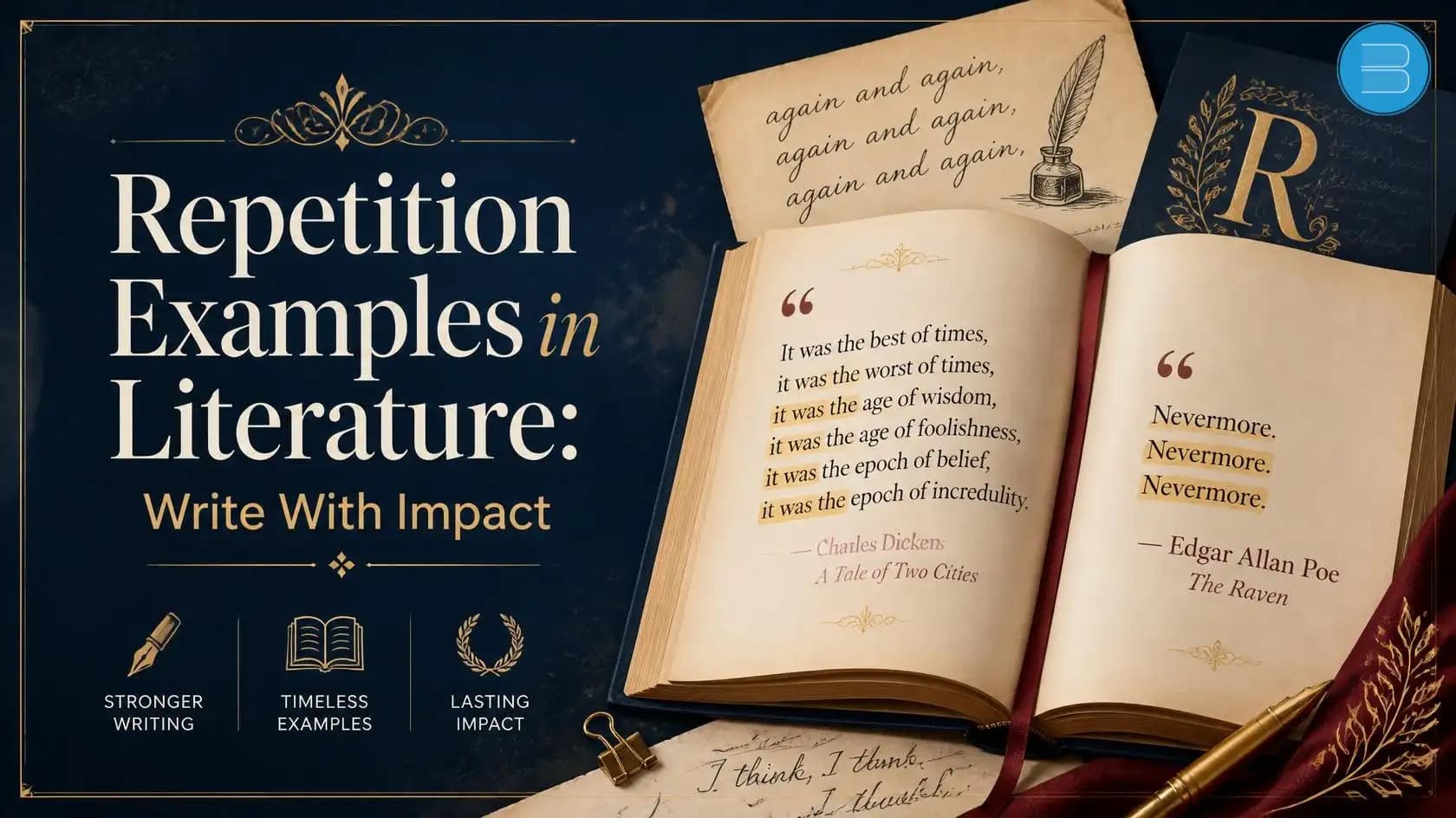
Have you ever read a passage in a poem or a line in a book that stayed with you long after you put the cover down? It’s likely that the author employed a classic literary technique to help you remember those words. As authors, poets, and readers, we frequently find it amazing how a few carefully chosen words may arouse strong feelings, generate uncontrollable momentum, or produce an eerie rhythm. Welcome to our definitive guide to repetition examples in literature.
You are at the perfect place whether you are looking for a motivational example of a poetry that uses repetition, studying classic texts, or attempting to find out how to include this approach into your own manuscript.
We will dissect repetition’s mechanics, examine its many manifestations, and examine why it functions so well in this conversational tutorial.
You may also like: Central Idea in Literature: Find Meaning with Examples
You may also read: 10 Realistic Fiction Books to Inspire Your Next Read — Explore Now!
What is Repetition in Literature? (And Why Do Writers Use It?)
At its core, repetition is the intentional reusing of words, phrases, sentences, or even entire narrative structures to create a specific effect.
Novice writers are often taught to avoid repeating themselves. We are told to consult the thesaurus and vary our vocabulary. But in the hands of a master, repetition isn’t a sign of a limited vocabulary, it is a musical instrument.
Writers use repetition to:
- Create Rhythm: Just like a drumbeat in a song, repeated words create a cadence that pulls the reader forward.
- Emphasize a Point: If an author says something three times, you know it is crucial to the theme or the plot.
- Build Tension: Repeated phrases can create a sense of claustrophobia, urgency, or obsession.
- Unify a Text: A repeated motif acts as a thread that stitches a long piece of work together.
According to the Poetry Foundation’s glossary of literary terms, repetition is one of the most fundamental principles of poetic form, acting as the foundation for rhythm and musicality in verse.
You may also like: How to Write Crime Fiction: A Step-by-Step Guide
You may also read: Blake Crouch Books: Find Your Next Sci-Fi Read
You may also like: Witchy Kitten Names to Find the Perfect Magical Match
5 Types of Repetition (With Repetition Examples in Literature)
Repetition isn’t just a single tool; it is a whole toolbox. Depending on where the repeated words are placed, the literary device takes on a different name and serves a different psychological function. Let’s look at the heavy hitters.
1. Anaphora: The Power of Beginnings
Anaphora is the repetition of a word or phrase at the beginning of successive clauses or sentences. It is heavily used in speeches, poetry, and dramatic prose to build an overwhelming emotional crescendo.
The Classic Example:
“It was the best of times, it was the worst of times, it was the age of wisdom, it was the age of foolishness…” — Charles Dickens, A Tale of Two Cities
Why it works: Dickens uses anaphora to emphasize the extreme dualities of the French Revolution. By hammering the phrase “it was the” over and over, he creates a hypnotic, sweeping tone that immediately grounds the reader in the chaos and contrast of the era.
2. Epistrophe: The Punch at the End
If anaphora is about the beginning, epistrophe (or epiphora) is its mirror image. This is the repetition of a word or phrase at the end of successive clauses.
The Classic Example:
“…and that government of the people, by the people, for the people, shall not perish from the earth.” — Abraham Lincoln, The Gettysburg Address
Why it works: Epistrophe creates a profound sense of finality and emphasis. In Lincoln’s case, ending each clause with “the people” cements the core theme of democracy in the minds of his listeners. It leaves a lasting echo.
[Image Placeholder: An infographic comparing Anaphora and Epistrophe with arrows pointing to the beginning and end of sentences. Alt Text: Infographic showing anaphora and epistrophe repetition examples sentences.]
3. Epizeuxis: The Sound of Obsession
Epizeuxis is the immediate repetition of a word in a sequence, with no other words in between. It is visceral, raw, and often used to convey extreme emotion, madness, or shock.
The Classic Example:
“Words, words, words.” — William Shakespeare, Hamlet
Why it works: When Polonius asks Hamlet what he is reading, Hamlet’s repetitive reply beautifully illustrates his feigned (or perhaps real) madness, his exhaustion with court politics, and his cynical state of mind. It is a brilliant, immediate emotional gut-punch.
You may also like: Scary Books for Adults: Find Your Next Chilling Read
You may also read: Christmas Card Sentiments to Make Every Message Warmer
4. Symploce: The Best of Both Worlds
Symploce combines anaphora and epistrophe. It is the repetition of words at both the beginning and the end of successive clauses.
The Classic Example:
“When there is talk of hatred, let us stand up and talk against it. When there is talk of violence, let us stand up and talk against it.” — Bill Clinton
Why it works: It acts like a frame around a changing subject. The rigid structure forces the audience to focus entirely on the words that change in the middle, making the contrast impossible to ignore.
5. Diacope: The Dramatic Interruption
Diacope is the repetition of a word or phrase with one or two intervening words. It is incredibly common in natural speech and dialogue.
The Classic Example:
“Bond. James Bond.” — Ian Fleming, Casino Royale
Why it works: The slight pause and interruption create swagger, confidence, and a distinct rhythmic signature. It is a tiny linguistic drum fill.
Want to dive deeper into other foundational writing techniques? Check out our guide on [Internal Link: 10 Essential Literary Devices Every Writer Should Know] (Use anchor text: essential literary devices).
You may also like: Anthony Bourdain Books: Explore His Life Through Writing
You may also read: 150+ Descriptive Words to Describe a Person – Find the Perfect Word
The Power of Poetry: Example of Poem with Repetition
If you are looking for an incredible example of repetition poem, you don’t have to look much further than classic American poetry. Poets rely on repetition not just for meaning, but for meter and musicality.
Let’s examine one of the most famous examples of all time.
Robert Frost’s “Stopping by Woods on a Snowy Evening”
“The woods are lovely, dark and deep, But I have promises to keep, And miles to go before I sleep, And miles to go before I sleep.”
The Breakdown: The final two lines of this poem are a masterclass in how repetition shifts meaning.
- The first “And miles to go before I sleep” reads literally: the narrator has a long physical journey on his horse before he can rest in a bed.
- The repeated line, “And miles to go before I sleep,” instantly shifts into the metaphorical. It becomes a weary reflection on the long journey of life and the obligations he must fulfill before his ultimate “sleep” (death).
By simply repeating the exact same words, Frost transforms a quiet winter scene into a profound meditation on human mortality and duty. This duality is exactly why studying an example of poem with repetition is so vital for emerging writers.
Edgar Allan Poe’s “The Raven”
No discussion of poetic repetition is complete without Poe. His use of the word “Nevermore” (an example of a repeating motif or refrain) serves as a psychological tolling bell.
“Quoth the Raven ‘Nevermore.'”
With each stanza, the narrator asks increasingly frantic questions, and the bird’s unchanging, repeated response slowly drives the narrator into madness.
Repetition here isn’t just pretty; it is the engine of the plot. To see more detailed analyses of Poe’s rhythmic genius, literary scholars at LitCharts offer fantastic breakdowns of how his repeated motifs build suspense.
Create Your Own: Repetition Examples Sentences
Understanding how the masters did it is one thing, but how do you apply this to your own manuscript? Whether you are writing a thriller, a memoir, or a sci-fi epic, constructing deliberate repetition sentences can elevate your prose from functional to unforgettable.
Here is a practical framework for writing your own repetition example sentences without sounding like a broken record.
Rule 1: Use Repetition for Emotional Extremes
Do not use epizeuxis (immediate repetition) when a character is buying groceries. Use it when they are terrified, furious, or heartbroken.
- Weak: “I really, really, really need a coffee.”
- Strong: “No, no, no,” she whispered, backing away from the locked door.
Rule 2: Anchor Your Paragraphs with Anaphora
If you are writing a persuasive essay, a speech, or a character’s impassioned monologue, try starting three consecutive sentences with the same phrase to build rhetorical momentum.
- Example: “We didn’t know how to fight. We didn’t know how to hide. We didn’t know anything except that we had to survive.”
Rule 3: The “Rule of Three”
Human brains are wired to recognize patterns, and three is the smallest number required to make a pattern. When experimenting with repetition sentences, group them in threes. This creates a satisfying, complete rhythmic loop for the reader.
Conclusion
Mastering repetition examples in literature is like learning to use shadows in a painting. When you first start writing, you might try to flood your prose with constant variety, fearing that saying the same thing twice is a mistake.
But as you study the greats, from Dickens to Frost to Poe, you realize that deliberate, strategic repetition is what makes words echo in a reader’s mind forever.
The next time you sit down to write, don’t be afraid to let your words loop, echo, and return to themselves.



0 Comments