
Oxford Comma Examples | Write Clearer, Cleaner Lists | Complete Guide

Have you ever written a list that looked perfectly normal, only to realize it could mean something completely different? That tiny punctuation mark before “and” or “or” can make a surprising difference. If you are searching for oxford comma examples, you are probably trying to understand when that final comma belongs in a list and when it does not.
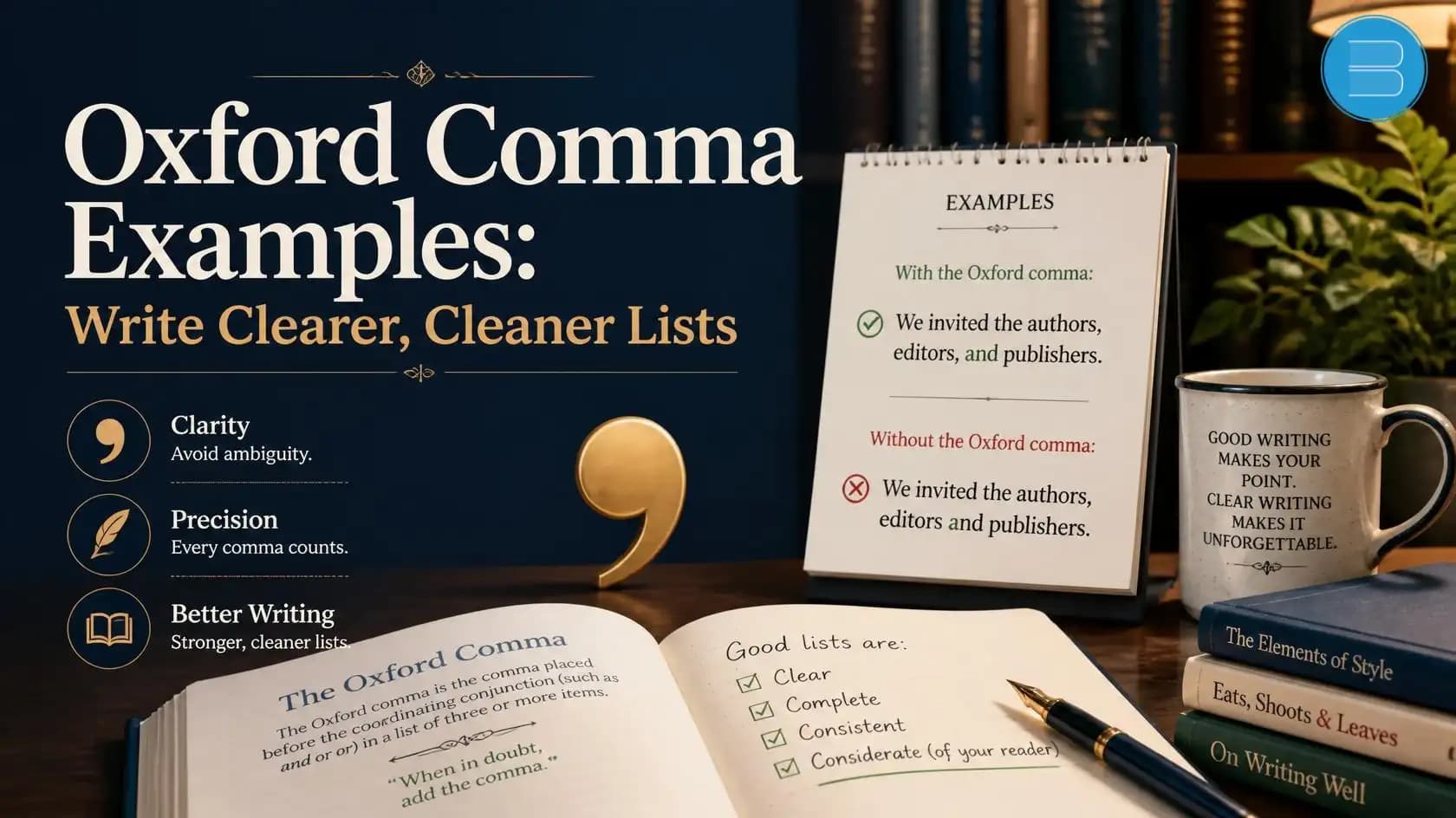
The Oxford comma, also called the serial comma, is the comma placed before the final conjunction in a list of three or more items:
I bought notebooks, pens, and folders.
The comma after “pens” is the Oxford comma.
For authors, poets, students, bloggers, editors, and anyone who works with words, understanding this punctuation choice is more than a grammar exercise. It can prevent ambiguity, improve rhythm, and occasionally save a sentence from becoming unintentionally hilarious.
This guide breaks down the rules with practical Oxford comma examples, funny cases, before-and-after comparisons, style-guide differences, and editing tips you can apply immediately.
- What Is the Oxford Comma?
- Oxford Comma Examples: The Basic Rule
- Why Does the Oxford Comma Matter?
- Oxford Comma Examples That Change Meaning
- Funny Oxford Comma Example: When Punctuation Gets Weird
- When Should You Use the Oxford Comma?
- When Is the Oxford Comma Not Necessary?
- Oxford Comma Examples: With vs. Without
- Oxford Comma Examples With Complex Lists
- Oxford Comma in a Sentence: A Simple Formula
- Oxford Comma vs. Other Commas
- Common Oxford Comma Mistakes
- Does the Oxford Comma Really Matter in Professional Writing?
- Funny Oxford Comma Examples: Why Writers Love Them
- Oxford Comma Style Guide: Which Rule Should You Follow?
- Quick Oxford Comma Cheat Sheet
- Final thoughts
- Frequently Asked Questions
You may also like: Central Idea in Literature: Find Meaning with Examples
You may also read: 10 Realistic Fiction Books to Inspire Your Next Read — Explore Now!
What Is the Oxford Comma?
The Oxford comma is the final comma used before “and” or “or” in a list containing three or more items.
Compare:
Without Oxford comma:
I packed books, clothes and shoes.
With Oxford comma:
I packed books, clothes, and shoes.
Both versions can be grammatically acceptable depending on the style guide you follow. The key difference is that the Oxford comma creates a stronger visual separation between the final two list elements.
It is called the Oxford comma because of its historical association with Oxford University Press. It is also commonly called the serial comma.
The Chicago Manual of Style favors the serial comma as a default, while acknowledging that punctuation should be applied with judgment rather than mechanically.
An easy way to remember it
Think of a three-part list as:
Item 1, Item 2, and Item 3.
The comma immediately before “and” is the Oxford comma.
Example of the Oxford comma
She bought apples, oranges, and bananas.
Here:
- Apples = first item
- Oranges = second item
- Bananas = third item
- Comma before “and” = Oxford comma
Oxford Comma Examples: The Basic Rule
The simplest rule is straightforward:
When listing three or more items, you may place a comma before the final “and” or “or,” depending on the style you are following.
Oxford comma in a sentence
Here are several everyday examples:
- I need paper, ink, and envelopes.
- She enjoys reading, painting, and gardening.
- The story contains mystery, romance, and adventure.
- Bring your passport, ticket, and identification.
- We discussed plot, characters, pacing, and dialogue.
- The poem explores love, loss, memory, and identity.
- You can choose tea, coffee, or juice.
In every example, the comma before the final conjunction separates the final item from the rest of the list.
When there are only two items
You do not need an Oxford comma when there are only two items.
I bought paper and ink.
There is no list of three or more items, so there is no serial comma.
You may also read: How to Write Crime Fiction: A Step-by-Step Guide
You may also like: Scary Books for Adults: Find Your Next Chilling Read
Why Does the Oxford Comma Matter?
The Oxford comma is not simply about putting an extra mark on a page. Its biggest advantage is clarity.
Consider:
I dedicate this book to my parents, John and Mary.
A reader could interpret John and Mary as the names of the parents.
Now compare:
I dedicate this book to my parents, John, and Mary.
The second version clearly presents three separate recipients: the writer’s parents, John, and Mary.
This is why punctuation can influence meaning.
Purdue’s writing resources similarly describe the Oxford comma as the final comma in a series and highlight its usefulness for clarity.
The Oxford comma as a clarity tool
For writers, a useful principle is:
Do not use punctuation merely because a rule tells you to. Use it to help the reader understand your meaning.
The Chicago Manual of Style notes that serial commas can be necessary to prevent awkwardness or ambiguity.
Oxford Comma Examples That Change Meaning
Some of the most useful examples involve sentences where removing the comma creates genuine ambiguity.
Example 1: The dinner invitation
Without Oxford comma:
I invited my cousins, a poet and a novelist.
This could suggest that the cousins themselves are a poet and novelist.
With Oxford comma:
I invited my cousins, a poet, and a novelist.
Now the list clearly contains three groups or people.
Example 2: A dedication
Without Oxford comma:
This book is dedicated to my editor, Jane Austen and George Orwell.
The wording can momentarily make readers wonder whether Jane Austen and George Orwell identify the editor.
With Oxford comma:
This book is dedicated to my editor, Jane Austen, and George Orwell.
The three entries are visually separated.
Example 3: The shopping list
Without:
We bought bread, cheese and vegetables.
Usually, there is no meaningful confusion.
With:
We bought bread, cheese, and vegetables.
The list is unmistakably composed of three separate items.
This illustrates an important point: the Oxford comma is often optional when the meaning is already obvious. It becomes especially valuable when the items could be grouped differently.
You may also like: Christmas Card Sentiments to Make Every Message Warmer
Funny Oxford Comma Example: When Punctuation Gets Weird
The internet loves the Oxford comma because punctuation mistakes can produce surprisingly funny sentences.
A classic structure is:
I invited the strippers, JFK and Stalin.
Without the final comma, a reader could momentarily interpret JFK and Stalin as the strippers’ names.
With the Oxford comma:
I invited the strippers, JFK, and Stalin.
Now the list is much easier to parse.
The humor comes from the fact that punctuation changes the apparent relationship between the words.
Another funny Oxford comma example
The party was attended by the dogs, the neighbors and the mayor.
That sounds normal.
But imagine:
The party was attended by the dogs, the neighbors, and the mayor.
The final comma makes the three groups unmistakably separate.
Oxford comma funny examples for writers
Try these:
My favorite authors are Tolkien, Rowling, and my grandmother.
Without the final comma, the relationship between the final names becomes less immediately clear.
Another:
The workshop covered poetry, fiction, and famous authors.
Compare that with:
The workshop covered poetry, fiction and famous authors.
Neither is inherently confusing, but the Oxford comma provides a cleaner visual boundary.
The lesson behind these Oxford comma funny examples is not that every sentence requires the comma. It is that punctuation can affect how quickly readers understand the structure.
You may also like: Anthony Bourdain Books: Explore His Life Through Writing
You may also read: 150+ Descriptive Words to Describe a Person – Find the Perfect Word
When Should You Use the Oxford Comma?
If you are writing a book, article, essay, blog post, or manuscript, use the following checklist.
1. Use it when a list could be ambiguous
Using the Oxford comma when leaving it out could make the meaning of a list unclear or confusing. It helps readers distinguish the final two items, especially when one item contains a conjunction or could be mistaken for an explanation of the previous item.
This simple punctuation choice can make your writing more precise and easier to understand.
She thanked her parents, her editor, and her publisher.
The comma clearly separates each recipient.
2. Use it when list items are long
Use the Oxford comma when list items are lengthy, contain internal commas, or have complex descriptions. It separates each item more clearly, helping readers understand where one element ends and another begins. This is especially useful in detailed sentences, professional writing, and academic content.
The course teaches character development, effective dialogue techniques, and methods for building suspense.
Longer items benefit from visual separation.
3. Use it when list items contain “and”
Consider:
The book explores love and loss, war and peace, and hope and redemption.
The serial comma makes the three paired concepts easier to identify.
4. Use it when the final two items could be mistaken as one unit
When the final two items in a list could be read as a single phrase or unit, the Oxford comma can prevent confusion. It clearly separates each item, making the intended meaning easier to understand. This is especially useful when the final items are closely related.
The shelves contain biographies, historical novels, and poetry collections.
The comma makes the final boundary obvious.
5. Use it consistently
Once you choose to use the Oxford comma, apply it consistently throughout your writing. Switching between styles can confuse readers and make your work appear inconsistent.
For books, articles, and professional content, maintaining one punctuation style improves readability and gives your writing a polished, professional appearance.
When Is the Oxford Comma Not Necessary?
The Oxford comma is not a universal requirement.
If a list is extremely simple and unambiguous, many writers omit it:
I bought bread, milk and eggs.
The meaning is immediately clear.
Style guides also differ. The Chicago Manual of Style favors the serial comma, while some major editorial styles, including AP style, generally omit it in straightforward lists.
In British English, usage also varies. Oxford University Press favors retaining it, while other British publishing conventions may omit it. Consistency is important either way.
The most important rule
Follow the style guide required by your publisher, publication, institution, or client.
If no specific style guide applies, choose one approach and use it consistently.
Oxford Comma Examples: With vs. Without
A side-by-side comparison makes the difference easier to see.
| Without Oxford Comma | With Oxford Comma |
| I bought pens, paper and ink. | I bought pens, paper, and ink. |
| She likes poetry, fiction and drama. | She likes poetry, fiction, and drama. |
| We invited Anna, David and Priya. | We invited Anna, David, and Priya. |
| The story has mystery, romance and humor. | The story has mystery, romance, and humor. |
| Choose tea, coffee or juice. | Choose tea, coffee, or juice. |
In most of these examples, both versions communicate the same basic idea.
The real benefit becomes visible when the items themselves are complicated or potentially connected.
You may also like: Writing Dialogue: Make Every Conversation Feel Natural
You may also read: Famous Spanish Authors: 15 Writers You Must Read
Oxford Comma Examples With Complex Lists
This is where the punctuation becomes particularly useful.
Imagine a sentence containing multiple categories:
The conference included sessions on publishing contracts, book marketing and advertising, and copyright protection.
Without the serial comma, the phrase “book marketing and advertising” could be read as two separate list items or as one combined item.
The Oxford comma helps:
The conference included sessions on publishing contracts, book marketing and advertising, and copyright protection.
Here, the structure becomes:
- Publishing contracts
- Book marketing and advertising
- Copyright protection
Another example
The author studied novels from India, the United Kingdom and the United States, and contemporary poetry.
The comma before the final “and” helps separate the geographic grouping from the final subject.
When lists become complicated, punctuation becomes a navigation system for the reader.
You may also like: Windy City Series: Discover the Books in Order
You may also read: How to Write Adventure Fiction: The Ultimate Step-by-Step Guide
Oxford Comma in a Sentence: A Simple Formula
If you are unsure how to construct an Oxford comma in a sentence, use this pattern:
A, B, and C.
For four items:
A, B, C, and D.
For five:
A, B, C, D, and E.
The final comma always appears immediately before the coordinating conjunction.
With “or”
The same principle applies:
You can submit the manuscript by email, post, or courier.
Or:
The prize may be awarded to the author, editor, translator, or publisher.
The Oxford comma can appear before “or” just as it can before “and.”
Oxford Comma vs. Other Commas
One common mistake is assuming that every comma in a list is an Oxford comma.
It is not.
Consider:
She opened the book, smiled, and began reading.
The comma before “and” is a serial comma because the sentence contains three coordinated actions.
But commas can perform many other jobs:
- Separating introductory elements
- Joining certain clauses
- Setting off nonessential information
- Separating adjectives in appropriate constructions
- Organizing items in a series
BlueRose’s guide to punctuation also identifies the serial/Oxford comma as one specific use among several comma functions.
Understanding the difference helps you avoid treating punctuation as a collection of isolated rules.
You may also like: Thanksgiving Words List: 250+ Festive Terms & Phrases
You may also read: Never After Series in Order: Complete List Guide
Common Oxford Comma Mistakes
Even experienced writers can misuse the serial comma.
Mistake 1: Adding it to a two-item list
Incorrect:
I enjoy poetry, and fiction.
Better:
I enjoy poetry and fiction.
The comma is unnecessary because there are only two coordinated items.
Mistake 2: Using it inconsistently
For example:
The story contains mystery, romance, and suspense.
The sequel contains drama, fantasy and humor.
There is nothing grammatically disastrous here, but the inconsistent style looks careless in a polished manuscript.
Mistake 3: Assuming it solves every ambiguity
Sometimes an Oxford comma is not enough.
If a sentence contains complicated nested relationships, rewriting may be clearer.
Instead of:
She interviewed authors, editors, and publishers with international experience.
Consider:
She interviewed internationally experienced authors, editors, and publishers.
Or:
She interviewed authors, editors, and publishers who had international experience.
Good editing is not about adding commas everywhere. It is about making meaning unmistakable.
Mistake 4: Letting punctuation replace good sentence structure
If a sentence becomes difficult to understand even after punctuation is corrected, rewrite it.
A clean sentence beats a heavily punctuated sentence.
You may also like: What Are the 48 Laws of Power? All Laws Explained
Does the Oxford Comma Really Matter in Professional Writing?
Yes—although its importance depends on context.
In casual communication, the difference may be negligible:
I bought apples, oranges and bananas.
Nobody is likely to misunderstand you.
But in professional, legal, academic, technical, or published writing, ambiguity can have consequences.
One famous example involved a dispute over overtime-pay language in Maine. The absence of a serial comma became central to how a law was interpreted in litigation involving delivery drivers. Purdue’s writing material highlights the case as an example of how a missing Oxford comma can affect interpretation.
The broader lesson is valuable:
Tiny punctuation choices can become important when precise meaning matters.
That is why professional writers should treat punctuation as part of communication—not merely decoration.
Funny Oxford Comma Examples: Why Writers Love Them
The Oxford comma has become a recurring source of internet humor because punctuation can accidentally create bizarre relationships between words.
The classic formula is:
I invited [Group], [Person 1], and [Person 2].
Remove the comma, and the final names can appear to describe the group.
For example:
Potentially ambiguous:
I thanked my teachers, Shakespeare and Virginia Woolf.
Clearer:
I thanked my teachers, Shakespeare, and Virginia Woolf.
The second sentence makes the intended grouping immediately apparent.
Why these examples are useful
Funny examples are memorable because they demonstrate an important writing principle:
Readers process punctuation structurally.
They don’t merely see commas as pauses. They use them to determine which words belong together.
For aspiring authors, this is a useful reminder that punctuation influences the reader’s interpretation of your prose.
Oxford Comma Style Guide: Which Rule Should You Follow?
There is no single universal rule that every English-language publication follows.
Chicago style
Chicago generally favors the serial comma and recommends it as a consistent default. It also emphasizes judgment when punctuation does not improve meaning.
Oxford style
Oxford’s own style tradition supports retaining the serial comma but allows omission in appropriate circumstances. Consistency is emphasized, particularly when the comma is needed to prevent ambiguity.
AP style
AP style generally avoids the serial comma in simple lists unless the comma is necessary for clarity. Chicago explicitly notes this difference between major style traditions.
What should an author do?
If you are preparing a manuscript:
- Check your publisher’s style sheet.
- Check your editor’s preferences.
- Follow the required style guide.
- Apply the choice consistently.
- Prioritize clarity when ambiguity appears.
There is no prize for using the Oxford comma everywhere. There is, however, considerable value in making your writing easy to understand.
Quick Oxford Comma Cheat Sheet
Remember these five rules:
- Three or more items? An Oxford comma may appear before the final “and” or “or.”
- Two items? You generally do not need one.
- Ambiguous list? Use the comma or rewrite the sentence.
- Following a style guide? Follow its requirements.
- Writing a book? Be consistent throughout the manuscript.
The formula
A, B, and C.
Example
She loves reading, writing, and editing.
Without it
She loves reading, writing and editing.
Both can be acceptable depending on the style, but the first makes each element visually distinct.
Final thoughts
The Oxford comma may be tiny, but it can have a big impact on clarity. As these oxford comma examples demonstrate, the punctuation mark can separate ideas, prevent unintended meanings, and make complicated lists easier to understand.
The key is not to treat the Oxford comma as a rigid rule that must appear everywhere. Instead, understand why it exists, know what your preferred style guide requires, and use it consistently.
For writers, the best punctuation is punctuation that disappears into the reading experience. Your reader should focus on your story, argument, poem, or idea, not stop to wonder what your list means.
So, the next time you write a sentence containing three or more items, pause for a second:
Would the Oxford comma make my meaning clearer?
If the answer is yes, use it or rewrite the sentence so the meaning is unmistakable.
And if you’re preparing a manuscript for publication, don’t stop with punctuation. Review your grammar, structure, consistency, and overall readability before sending your work to an editor or publisher.
Clear writing begins with clear choices.
Frequently Asked Questions
What is an Oxford comma?
An Oxford comma is the comma placed before the final “and” or “or” in a list of three or more items. For example: “I bought apples, oranges, and bananas.”
What is an example of the Oxford comma?
A simple example of the Oxford comma is: “She packed books, notebooks, and pencils.” The comma immediately before “and” is the Oxford comma.
Can an Oxford comma change the meaning of a sentence?
Yes. In some sentences, omitting the comma can make two items appear to belong together or can create an unintended interpretation. Adding the comma can make the intended grouping clearer.
Is an Oxford comma the same as a serial comma?
Yes. Oxford comma and serial comma are two names for the same punctuation mark: the final comma in a list before the coordinating conjunction.



0 Comments